Updated 5:40 pm ET, Wednesday, May 9
Usually, it’s Twitter’s users that make and break news. But on Tuesday, the company itself became the subject of headlines after filing a motion in New York City criminal court arguing that it should not have to turn over a user’s tweets to authorities.
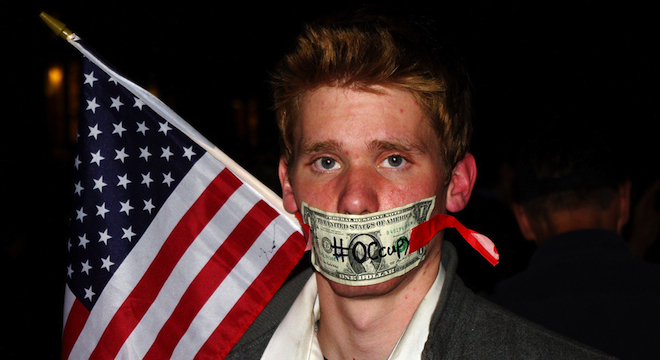
Twitter’s motion came after the Manhattan District Attorney’s office subpoenaed the San Francisco-based company in January, ordering it to turn over three-months worth of tweets and personally identifying information of a user, Malcolm Harris, who had been arrested along with many others during an Occupy Wall Street protest in New York in October.
Harris had attempted to challenge the subpoena on his own but a New York judge ruled against him in late April, ordering Twitter to turn over the information.
Twitter, though, says it won’t be doing so, at least for now, because doing so would violate several other existing laws, among them the Fourth Amendment right to unreasonable search and seizure.
Experts in cyber law told TPM that Twitter’s stance in Harris’ case was undeniably important and could prove to be a landmark one for user privacy and law enforcement’s ability to access user information going forward.
“Twitter’s argument that tweets are content, that users own their tweets, and that the Supreme Court’s Jones decision means that the public nature of tweets doesn’t detract from users’ privacy interest in them is new and important,” said Susan Freiwald, a professor in cyber law at the University of San Francisco, in an email to TPM.
Freiwald was referring to the Supreme Court’s ruling in January against law enforcement using GPS to track suspects without a warrant.
Freiwald is a staunch civil libertarian, and “regularly assists the Electronic Frontier Foundation,” an advocacy group dedicated to protecting Web user rights, and has served on the board of the ACLU of Northern California. The ACLU’s national arm applauded Twitter on Tuesday for taking the stand against the Manhattan DA.
Another legal expert, professor Jonathan Zittrain at Harvard Law and the co-founder of Harvard’s Berkman Center for Internet & Society, told TPM via email that the case was further complicated by the mechanics of Twitter itself.
“The interesting twist here is that the tweets are, or were, public — they just scrolled off,” Zittrain said, referring to the tweets that the Manhattan DA was seeking Twitter turn over. “Twitter presumably reserves the right through its terms of service to decide that the tweet archive will jump to, say, one year instead of several weeks, and if Twitter can do that, goes the argument, why can’t the government simply request the materials?”
Zittrain said that the Supreme Court’s ruling against warrantless GPS tracking also bolstered Twitter’s arguments: “It’s just not as easy as that, from my point of view, and Twitter’s brief crystallizes the arguments why, particularly in light of the recently-decided Jones case,” Zittrain said.
However as Zittrain noted, the the fact that tweets are fast-paced and short-lived may contribute to the very success of the medium itself, as well its adoption by activists around the globe.
“People right now may tweet more freely publicly because they know those tweets are a little evanescent, and that could be a good thing,” Zittrain wrote.
Zittrain, it should be noted, is also a co-founder of Chilling Effects, a website that documents free speech and curtailing efforts online. Twitter committed to using Chilling Effects to post requests to takedown or censor content, which it routinely receives from governments around the globe.
Both Zittrain and Freiwald declined to speculate on the judge’s likely ruling, and thus the outcome of, Twitter’s motion.
However, both agreed that the Twitter case was important in determining the future of “third party doctrine,” that is, that doctrine the information users share with a third party company, such as Twitter or a bank, may be given by that third party to law enforcement without a warrant, so long as law enforcement agencies obtain a subpoena. However, Twitter argues out that according to the Stored Communications Act of 1986, handing over user communication that is over 180 days old requires a warrant, which the Manhattan DA has not yet obtained.
Editor’s note: Updated to correct Prof. Zittrain’s quote from “in like” to “in light.” Also updated with further information on “third party doctrine.”