Democrats’ crushing loss in the Wisconsin recall has forced a round of self-examination within the party over how to best spend precious resources: building a sophisticated ground game, or bulking up their presence in TV attack ads. Democrats in Ohio — a battleground state considered the top electoral prize by both campaigns — have landed squarely on the former.
After a 7-to-1 spending advantage helped Gov. Scott Walker defeat his recall in Wisconsin earlier this month, Democratic Congressional Campaign Committee Chairman Steve Israel sent out a panicked email. “The Wisconsin results should serve as a wake-up call for Democrats,” he wrote. “[O]n the ground organizing is critically important, but it must be coupled with an aggressive air campaign.”
The rest of the party is sounding a similar alarm, worrying about being massively outspent in the first election cycle since the Supreme Court’s Citizens United decision opened the floodgates of unlimited campaign spending. If Wisconsin showed anything, they say, it’s that Democrats’ ground operation was no match for Republicans’ air campaign, which aims to hit $1 billion this cycle.
But in Ohio — a state no Republican has won the presidency without — state Democrats insist that their massive ground game will repel whatever Republican bombardment comes over the airwaves.
“You know the old saying: Can’t buy me love,” Chris Redfern, chairman of the Ohio state Democratic Party told TPM. In Ohio, Redfern said, “We’re fully confident that infrastructure will overcome massive amounts of money on television.”
Redfern, a former House Minority Leader, has staked his reputation on taking the Ohio Democratic Party from an organization in shambles to one with the most sophisticated ground-game operation of any state party in the country. The party’s website boasts of Redfern’s “88-County Strategy,” which “recognizes that Democrats win by competing for votes in every area of Ohio,” it reads. Ohio Democrats believe the strategy helped win big victories in 2006, 2008 and 2011.
“The fact of the matter is, you cannot invent infrastructure overnight. It has to be sustained, it has to be well-funded,” Redfern said. In 2005, when Redfern took the helm, the party was in tatters and had only six employees, he said. Now they have more than 100, the largest of any state Democratic party in the nation. Combined staffing for the Obama campaign in Ohio, Democratic Sen. Sherrod Brown’s re-election campaign and the Ohio Democratic Party will be about 500 people, with thousands of volunteers, said Redfern. Redfern says this summer they will have offices in all 88 counties, with up to seven offices in some locations — on top of the 100 field offices the Obama campaign intends to have in the state.
“It was awful for a long time,” Ohio Democratic consultant Sandy Theis said of the state party before Redfern’s tenure. “Chris Redfern brought in some really good people.” By the time Democrats and labor scored a big victory in November 2011 when voters repealed anti-union SB 5, the party had become “a well-oiled machine.”
Unlike Israel and other Democrats in Washington, Redfern believes a superior ground game can win in a post-Citizens United era. Even Democrats’ impressive mobilization efforts in Wisconsin, Redfern said, had nothing on the type of investment his party has put into Ohio.
But Ohio Democrats say Ohio’s diverse population — 11 million people spread across cities, industrial pockets and rural areas — makes the ground game paramount in ways it might not be in other states. “No television message can fit the entire state,” said Redfern.
Democrats argue that the Romney will underestimate this fact, and instead rely largely on television to get their message across. Mitt Romney is running a “traditional” campaign in the mold of 1996, 2000 or 2004 “when a presidential campaign would parachute in in mid-summer,” Redfern said. “They would essentially try to buy their way to a win with the airwaves.”
Redfern believes Romney’s ground game won’t be up to par. “They’ll try to ship in activists who won’t know how to pronounce ‘Xenia,’ let alone know the neighborhood,” he said. “They won’t have the connection, literally, the cultivated relationship that we have with voters in those communities across the state. It’s something we’ve built since late 2005 early 2006, we’re very proud of it and we’ll be successful in this state because of it.” (It’s pronounced Zeen-yuh.)
Mitt Romney opened his first field office in Columbus a few weeks ago. Neither the Romney campaign nor the Ohio GOP responded to requests for comment.
But Romney’s campaign has talked up its own on-the-ground efforts in Ohio. Romney’s Ohio state director Scott Jennings told the Columbus Dispatch they would “match [Democrats] volunteer for volunteer on the ground.” Romney’s press secretary in Ohio, Chris Maloney, also touted the campaign’s ground game to the Dispatch. “We are light-years ahead of where we expected to be at this point,” he said.
Ohio Democrats are bracing for $100 million in attacks from the Romney campaign and a network of deep-pocketed outside groups. “[Democrats are] not gonna be able to match them in the money,” said Theis. “So I think the ground game is going to be more important than usual.”
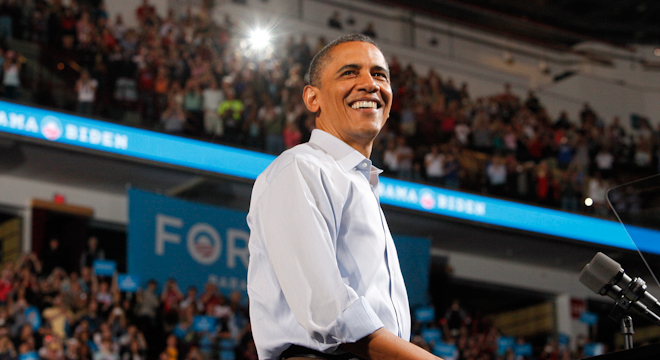
The Obama campaign is making ground operations central to its Ohio strategy as well.
“There is no replacement for a personal conversation between neighbors — and no amount of money can counter the power of a personal conversation like this between neighbors and friends,” Jessica Kershaw, the Obama campaign’s Ohio press secretary, told TPM.
“The Democratic playbook in Ohio is to organize neighbor to neighbor, door to door, and the Obama camp is doing that,” said Seth Bringman, a Democratic consultant in Ohio and the former press secretary for the state party.
But Theis warned that Democrats should not underestimate the impact of negative TV ads. Some Democrats dismiss their impact by assuming that voters get tired of the ads, or eventually tune them out, thereby minimizing their effect.
“The reason people spend so much time and money on them is that they tend to work,” Theis said.
Theis said she believes attack ads by moneyed GOP outside groups are the reason Republican Josh Mandel is polling so closely to incumbent Ohio Sen. Sharrod Brown. “[Mandel’s] the recipient of all this outside money that’s doing all this anti-Sherrod stuff and has been for a couple of months,” said Theis, who attributes the single-digit spread between the candidates to the outside attacks. “Sherrod should be beating him by 20 right now, and the fact that he’s not is a little troubling.”