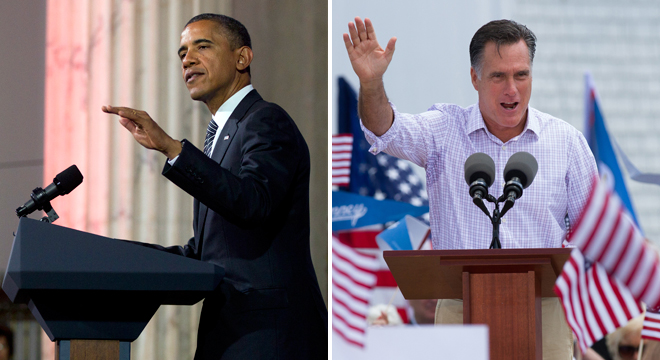
Will “anyone but Obama” be enough for Mitt Romney?
A Pew poll released Thursday shows the former Massachusetts governor within striking distance of President Barack Obama, but also indicates that anti-Obama sentiment outweighs pro-Romney enthusiasm among Republicans.
Obama leads Romney 50 percent to 46 percent nationwide, a tighter spread from a Pew poll conducted mostly in May that showed Obama with a 7-point lead.
“I think recent history suggests that an intense dislike of the president is enough to carry the day for the opposition party in midterm elections — witness both 2006 and 2010, but whether it is enough to carry a presidential election is another question,” Michael Dimock, associate director of research at Pew, told TPM in an email. “Plenty of Republicans were pretty unhappy with Clinton in 1996, but that certainly didn’t come close to getting a less-than-inspiring candidate over the top. And Democratic frustration with Bush was palpable in 2004, but couldn’t carry the day.”
But the Pew numbers show that the race remains tight even in the absence of strong enthusiasm for Romney. Romney leads by 8 points, 49 percent to 41 percent, on which candidate would be best at improving the economic conditions in the county. When Pew asked registered voters to compare the two men on other political attributes — “Connects with ordinary Americans,” “Willing to work with other party,” “Shares my values” and so on — Obama led all of them.
The internals of the poll show most of the trends the race has exhibited so far — a major gender gap exists, with Obama leading women by 15 points, 55 percent to 40 percent (Romney takes men by 10, 53 percent to 43 percent), while Romney maintains a 5-point lead with independents, 49 percent to 44 percent. Obama attracts about one-fourth of self-described “conservative” voters, 24 percent, while Romney only takes 14 percent of liberals. Taken together, the 4-point lead overall for Obama seems to come from a more committed base.
But while President Obama leads the overall race, an engagement gap persists. Romney voters are more likely than Democrats to be up on the presidential race. The percentage of younger voters interested in the election (a key demographic for the Obama campaign) is down about 12 points.
That didn’t immediately translate, however, into support for Romney. “Democrats are clearly more enthusiastic about voting for Obama than Republicans are about voting for Romney,” Pew wrote in its analysis. “Sixty percent of Obama’s supporters back him strongly, compared with just 38 percent of Romney voters support him strongly. An earlier Pew survey taken in May and June found 72 percent of Obama supporters believed their choice was more a vote for Obama than against Romney. Fifty-eight percent of Romney voters, by contrast, said their vote was against Obama more than for Romney.”
“Democratic dislike of George W. Bush was comparably intense to how Republicans feel about Obama today,” Dimock wrote. “But the Democrats in 2004 actually felt pretty good about Kerry in a way that Republicans do not, yet, today.”
The PollTracker average of the national presidential race shows Obama with a 2.2-point lead.
The Pew poll used 1,563 live telephone interviews with registered voters conducted from June 7-17. It has a sampling error of 2.9 percent.