When senators struck a bipartisan deal earlier this week to avert a filibuster rules change by Democrats, what exactly did they agree to, and how would it be enforced?
The agreement, negotiated by Senate Majority Leader Harry Reid (D-NV) and Sen. John McCain (R-AZ), was that Republicans would clear the way for seven of President Obama’s picks to lead federal agencies and departments. No more filibusters by Republicans on those seven. The catch, for Obama, was that he would have to withdraw his two recess-appointed nominees to the National Labor Relations Board and replace them with new nominees.
Although top Democratic aides say they expect Republicans to follow through, the agreement is less than ironclad and could potentially fall apart if any of the nominees don’t receive the 60 votes needed to break a filibuster. In that scenario, the only tool Reid would have is to resort to the same nuclear option to change the rules that the deal was meant to avoid in the first place.
A sign of the agreement’s fragility came Wednesday afternoon when the nomination of Tom Perez for labor secretary overcame the GOP filibuster on a 60-40 vote. One fewer vote and he’d have been blocked, essentially voiding the agreement.
The two NLRB nominations will be the true test of whether the agreement holds. President Obama has withdrawn Sharon Block and Richard Griffin to the board, and instead nominated Nancy Schiffer, the associate general counsel for AFL-CIO, and Kent Hirozawa, the chief counsel to NLRB’s chairman Mark Pearce.
The agreement was that those two nominees would be fast-tracked and reported out of committee in lieu of the usual potentially lengthy vetting process, according to a Senate aide. Reid’s office says the nominees would have to be confirmed by Aug. 27 and insists that the deal requires Republicans to permit cloture on any individuals selected by Obama. GOP leadership aides dispute the last part.
“We certainly haven’t agreed to that,” said one senior Senate Republican aide. “I don’t know about everyone. We’ll have hearings.”
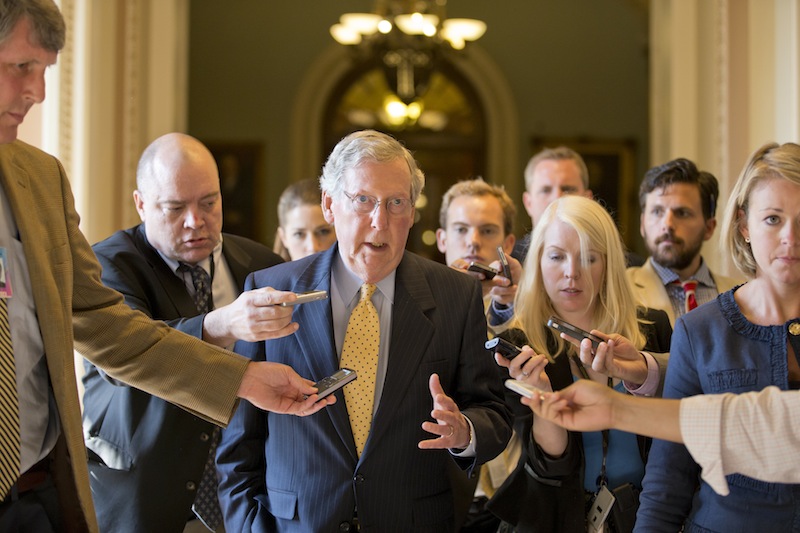
Senate Minority Leader Mitch McConnell (R-KY), who is protecting his right flank as he faces reelection next year, is publicly downplaying the idea that he was circumvented in the negotiations. According to Roll Call, he privately expressed frustration to his members that he could have gotten a better deal, and presented a version of events that caused Sen. Bob Corker (R-TN) to cry “bullshit” during a closed-door meeting.
Democrats are instead counting on McCain and a cohort of more moderate Republicans to deliver the votes. If they don’t, Reid has made amply clear that he retains his right to go nuclear. At the end of the day, that’s the only real backstop Democrats have to ensure that existing and future executive nominations are gummed up by the minority.
As Reid posted on Twitter after the deal was struck:
We retain the right to change the rules if necessary. But this is a new day in the Senate, and I hope we’ll be able to work together.
— Senator Harry Reid (@SenatorReid) July 16, 2013
The deal has held so far. The Senate voted 66-34 on Tuesday to confirm Richard Cordray to lead the Consumer Financial Protection Bureau (an agency Republicans wish never existed); 82-17 on Wednesday to end the filibuster of Fred Hochberg to lead the Export-Import Bank; and 54-46 on Thursday to confirm Perez. The Senate voted 69-31 on Thursday to advance Gina McCarthy’s nomination to the Environmental Protection Agency.
McConnell publicly characterized the deal as a positive step, even as he voted to filibuster Cordray, Hochberg, Perez and McCarthy.