


The Supreme Court on Monday rejected, 5-4, Republicans’ attempt to limit which mail ballots can be counted, an effort which would have unleashed chaos and disenfranchised voters for the 2026 midterms and beyond.
The Republican National Committee had sued Mississippi, one of many states that accepts ballots mailed by Election Day but received by election administrators after that date.
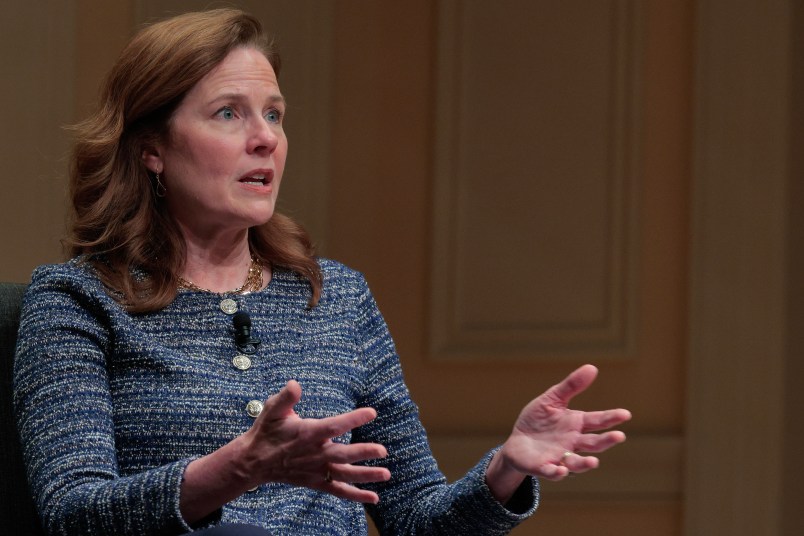
“The federal election-day statutes do not prevent Mississippi from counting absentee ballots postmarked by election day but received up to five days thereafter; nothing in the federal election-day statutes requires ballots to be received by election day,” wrote Justice Amy Coney Barrett for the majority.
Barrett was joined by Chief Justice John Roberts and the three liberals. Justice Samuel Alito wrote a dissent, joined by Justices Neil Gorsuch and Clarence Thomas in full, and Justice Brett Kavanaugh in part.
The RNC argued that federal statutes establishing election “day” bar officials from counting ballots that were mailed timely but arrive days later. The theory was always fairly holey, though, as Barrett pointed out.
“Although the election-day statutes refer to a particular ‘day’ for the election, plaintiffs do not contend that everything must occur on that day,” she wrote. “For instance, they do not object to early voting or dispute that officials may count votes and certify a winner after election day.”
The trumped-up concern about the “fraud” ushered in by the grace period, too, is incoherent.
“Plaintiffs and the dissent argue that if we uphold Mississippi’s law, States could put party bosses, ballot harvesters, or Uber drivers in charge of collecting ballots,” Barrett said. “Yet this would also be permissible under their interpretation, so long as the ballots are delivered by election day.”
In his dissent, Alito wrote that Election Day means the date by which the electorate’s choice needs to be made — which also, he claimed, includes the casting and collecting of ballots (though, strangely, not the counting).
He then spent pages on the parade of horribles that could follow Monday’s ruling. The alarm might ring more genuine if over half the states didn’t allow and manage grace periods currently.
“Allowing absentee ballots to pour in over the days and weeks after election day, by which point preliminary election returns are being publicly reported, creates greater opportunity for fraud and risks further undermining the public’s confidence in election integrity,” he wrote.
The opportunity for fraud seems to boil down to his notion that absentee voting is uniquely vulnerable to tampering, so any extension provides additional hours in which to tamper.
“It is undeniable that a prohibition on counting late-arriving ballots would provide an additional hurdle for bad actors seeking to stuff ballot boxes when early election results suggest a tight race,” he wrote.
Watson v. RNC is entirely born out of the right’s concerted effort to convince everyone from the president to Supreme Court justices to voters that voting fraud is a pernicious and ubiquitous feature of American elections. And that effort is entirely in service of creating pretext to impose restrictions that Republican officials think will hurt Democratic voters. It also has the more recent side effect of protecting President Donald Trump’s ego after he lost an election.
Alito and his fellow dissenters have completely bought in. During oral arguments, in lieu of evidence of widespread voting fraud, they crafted fantastical hypotheticals about retracted votes and neighbors dropping off other people’s ballots.
They often don’t even go that far — all they really need to justify upholding restrictions is the perception that voter fraud might be occurring. Unmentioned is their role, and that of Republicans from the president on down, in spreading this perception.
And even without the one-sided culpability is the radical idea that an unfounded perception justifies disenfranchising voters.
Against that backdrop, what’s really shocking about Monday’s ruling is that Republicans offered up an anti-voting rights case too weak for even the Roberts Court to accept. And still, four justices were prepared to change 30 states’ voting practices on the eve of a major election, in part due to the “perception” of fraud that Republicans created then weaponized.





I’m shocked, I fully expected them to tank vote by mail. I mean I’m happy, but still shocked.
Alito must have shit his robes when he saw how this was going down.
ACB, who from a purely actuarial standpoint likely has a long SCOTUS career ahead of her, continues to be an interesting one to watch.
The usual pattern is this: “oh, doesn’t seem so bad! Oh, this is okay!” and then, “oh, they saved the worst for last.”
ETA: there’s one!
The big one is birthright citizenship. Still to come.