


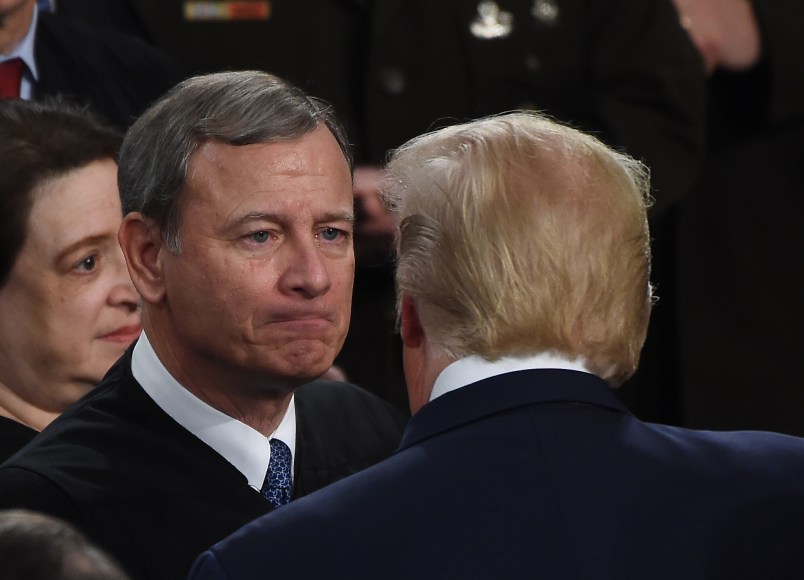
The Supreme Court blocked President Donald Trump’s signature economic and foreign policy Friday morning in a fractured 6-3 decision.
Trump cannot use the International Emergency Economic Powers Act, or IEEPA, to override Congress’s power of the purse, using the emergency declaration to levy widespread global tariffs, the majority held. The decision will now likely require an end to those tariffs, and could trigger the return of tariff revenue collected by Customs and Border Protection and deposited into the U.S. Treasury.
Chief Justice John Roberts wrote the majority opinion, which was joined in part by Justices Sonia Sotomayor, Elena Kagan, Neil Gorsuch, Amy Coney Barrett and Ketanji Brown Jackson. Kagan filed a concurring opinion, joined by Sotomayor and Jackson, while Jackson filed her own concurring opinion. Gorsuch and Barrett also filed concurring opinions.
Justices Clarence Thomas, Brett Kavanaugh and Samuel Alito dissented, with Thomas filing one dissenting opinion and Kavanaugh filing another, joined by Thomas and Alito.
“Based on two words separated by 16 others in [a section of] of IEEPA — ‘regulate’ and ‘importation’ — the President asserts the independent power to impose tariffs on imports from any country, of any product, at any rate, for any amount of time,” Roberts wrote. “Those words cannot bear such weight.”
The fact that the opinion arrived with three additional concurring opinions and two dissents perhaps helps to explain why SCOTUS took months to decide a case of vast economic and international importance, a delay that caused some to express surprise as weeks ticked by. (Others found the timing of the Court’s decision standard.)
The majority opinion ultimately agrees with the main argument of the plaintiffs, a slate of small businesses suing the government on the grounds that Trump’s IEEPA tariffs are illegal. Tariffs are a tax, the plaintiffs had argued, and taxing authority rests solely with Congress.
Quoting Alexander Hamilton, the majority noted that the nation’s founding was inspired in large part by “taxation without representation.” Congress would not have delegated its taxation power to the executive branch using ambiguous language like “regulate,” Roberts wrote.
The Court also referenced its own decision in the 2023 student loan forgiveness case, in which the Court used the major questions doctrine to rule former President Joe Biden did not have the authority to cancel more than $400 billion in student loan debt. The major questions doctrine holds that in the event a president issues a policy dealing with what the court labels as an issue of “vast economic and political significance,” the statute used must explicitly grant the executive those powers. Scholars had referenced that case when considering how the Supreme Court might rule on this one, recalling that the Court blocked Biden’s executive authority to cancel student loans, but weighing the conservative Court’s tendency to contort itself to Trump’s will.
Roberts’ majority opinion lingered on the government’s opinion that specific words in IEEPA, “regulate” and “importation,” granted the president tariff powers.
“It does not,” the opinion said.
Trump used the declaration of national emergencies about drug trafficking and historic trade deficits to justify levying tariffs under IEEPA, a claim the Court rejected in its ruling. That a president could simply declare an emergency and enact “a dizzying array of modifications at will,” which had enormous effects over the entire economy, is not a provision provided by IEEPA, the Court wrote. It also referenced Trump’s own claims about the staggering economic impacts of the tariffs to highlight the significance of Trump’s sweeping tariffs, which, the majority said, goes beyond authority delegated by IEEPA.
Before Friday’s decision, scholars had considered the Court’s skittishness to address economic and foreign policy issues. Roberts’ majority opinion addressed that, as well.
“We claim no special competence in matters of economics or foreign affairs,” the chief justice wrote. “We claim only, as we must, the limited role assigned to us by Article III of the Constitution.”
Conservatives Quarrel Over Major Questions Doctrine
In his concurring opinion, conservative justice Gorsuch became a spirited cheerleader for the major questions doctrine, challenging his colleagues’ interpretations of the statute in this case and past ones. He addresses Kagan, Sotomayor, Jackson, and his conservative colleague Barrett, who also concurred but who found that a standard interpretation of the language used in IEEPA, rather than the application of the major questions doctrine, was enough to find Trump lacked tariff authority.
Gorsuch also called out his fellow conservative justices, Kavanaugh, Thomas and Alito, for their contradictory application of legal principles.
“Still others who have joined major questions decisions in the past dissent from today’s application of the doctrine,” Gorsuch wrote before referencing the three dissenting justices. “It is an interesting turn of events.”
In one example regarding vaccine mandates, Gorsuch wrote, his liberal colleagues Sotomayor and Kagan used a broad interpretation of language to support the legality of the mandates. Yet here, Gorsuch needled, those justices concurred with a majority opinion that highlighted the broad and vague language in IEEPA to prohibit Trump’s executive powers.
Gorsuch spent time addressing his liberal colleagues’ previous challenges to the major questions doctrine, pushing the legal principle and noting the justices’ previous dissents from cases in which the majority cited the major questions doctrine. Gorsuch called the doctrine “pro-Congress,” responding to a dissent by Kagan in a 2022 case in which SCOTUS overturned an Obama-era effort by the Environmental Protection Agency to cap emissions.
Gorsuch interpreted Barrett as casting the major questions doctrine as just a “commonsense” interpretation of language based on reasonable understanding of words, phrases, and context clues. That interpretation doesn’t fly here, Gorsuch said, because IEEPA and other cases in which the doctrine is used do not possess concepts defined by commonly held beliefs or understandings. “Little about them,” Gorsuch writes, “‘goes without saying.’”
But Barrett said she’d never said that. Instead, she said the major questions doctrine is rooted and therefore “best understood as” plain text interpretation of a law, or textualism.
In her concurring opinion, joined by justices Sotomayor and Jackson, in part, Kagan found the major questions doctrine unnecessary in deciding the iEEPA case.
“Nothing in IEEPA’s text, nor anything in its context, enables the President to unilaterally impose tariffs,” she wrote.
Jackson’s concurring opinion, on the other hand, called use of the major questions doctrine needless, writing that historical evidence shows “that Congress did not intend for IEEPA to authorize the Executive to impose tariffs.” She went further, finding that Congress instead intended IEEPA to confer on the president powers to freeze transactions on foreign assets.
Dissents: Major Questions and Nondelegation Principles Don’t Apply Here
In his dissenting opinion, joined by Thomas and Alito, Kavanaugh held IEEPA’s text and legislative history authorizes the president to “regulate importation” using tariffs. He highlighted other statutes under which presidents have levied tariffs which Trump is using or has already used.
Major questions is not applicable in this case, insisted Kavanaugh, both because Congress authorized the president to levy tariffs under IEEPA and because the major questions doctrine does not apply “in the foreign affairs context, including in foreign trade.”
Interestingly, Kavanaugh used a paragraph to buoy the president’s future tariff success.
“Although I firmly disagree with the Court’s holding today,” he wrote, “the decision might not substantially constrain a President’s ability to order tariffs going forward.” Kavanaugh then highlighted the bevy of provisions Trump can use instead, “albeit perhaps with a few additional procedural steps that IEEPA… does not require.”
In a statement posted to Truth Social, Trump thanked Kavanaugh for his dissent and asserted he would be using the other, more restrictive statutes to uphold his tariff regime as much as possible.
“Our Country is the ‘HOTTEST” anywhere in the World, but now, I am going in a different direction, which is even stronger than our original choice,” Trump wrote on social media.
Leaning on an issue raised during oral arguments, Kavanaugh noted the burdensome difficulty that will now likely be placed on the government to repay U.S. importers who bore the brunt of the tariff costs. Even before Friday’s decision, companies began filing lawsuits against the Trump administration, lining up to receive payback for the tariff-induced increase in importation costs. Ninety percent of those costs fell on U.S. consumers and businesses, an analysis from the New York Federal Reserve found. Several other reports have come to the same conclusion: that U.S. companies and shoppers, not foreign entities, have paid Trump’s tariffs, filling the U.S. Treasury with their own U.S. dollars.
Thomas’ dissent disagreed in principle with the idea that Congress couldn’t delegate this aspect of its power of the purse to the president, and went so far as to eschew using the word “tariffs’ in favor of “duties,” in order to cast Trump’s signature economic policy tool as separate from taxation.
He addressed the major questions doctrine at the very end of his dissent.
Separation of powers doesn’t work here, Thomas held. The nondelegation principle — a theory similar to the major questions doctrine that holds Congress cannot delegate its constitutional powers — still allows Congress to cede many of its duties to the executive, Thomas writes, and the foreign policy nature of Trump’s tariffs helps support the president’s tariff authority under IEEPA.
“As I suggested over a decade ago, the nondelegation doctrine does not apply to ‘a delegation of power to make rules governing private conduct in the area of foreign trade,’ including rules imposing duties on imports,” Thomas said, referencing himself from a unanimous 2015 SCOTUS decision.


Can I sue Donald Trump too, like Costco?
Ha!
Coming next, the consequences.
Kavanaugh with the correct opinion (A) that the majority not requiring the federal government to refund the collected revenue is a major oversight and incorrect opinion (B) that since refunding tariff revenue will be a headache, it’s better to just rule the illegal tariffs legal instead.
A sterling legal mind, that one.
Hmmm… if the unitary executive connot use the IEEPA to override congress’ power of the purse, is it possible he need not, being as how he gets to do whatever he wants anyhow?