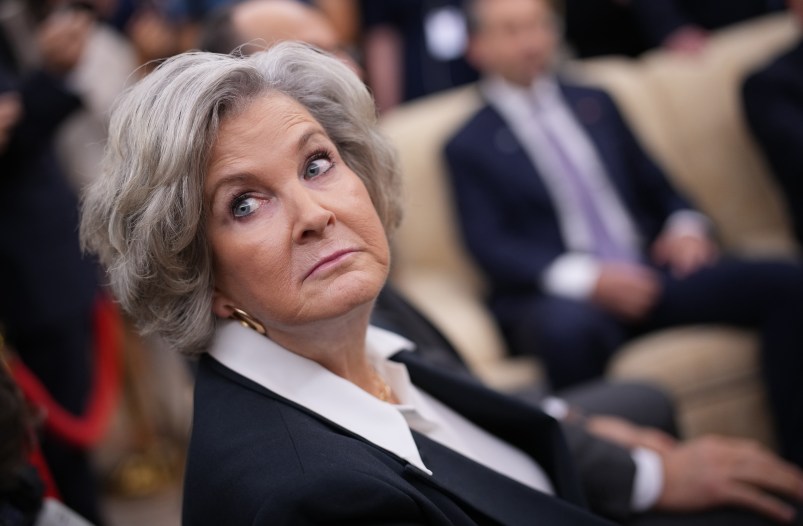
It was pretty obvious that White House chief of staff Susie Wiles’ admission to Vanity Fair that President Trump was engaged in “score settling” was going to make it into a legal filing sooner or later. Now it has.
In a filing overnight, Kilmar Abrego Garcia’s attorneys cited the Wiles interview as part of their bid to dismiss the indictment against him on vindictive prosecution grounds:
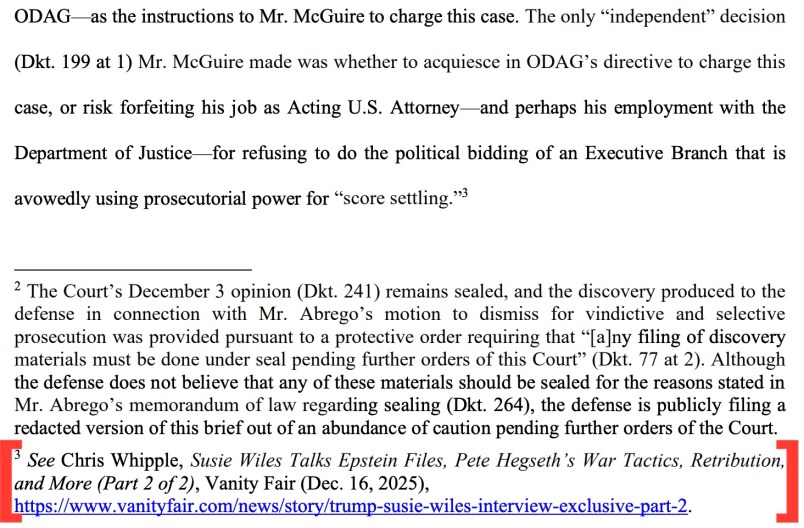
As a practical matter, we can say that of course it’s a vindictive prosecution. But as a legal matter, the standard to establish vindictive prosecution is high and hard to meet. Wiles’ comments alone won’t do the trick, but they are the capper to what has been a series of remarkable public commentaries, threats, and admissions about Abrego Garcia and his criminal case from high-ranking administration officials, chief among them Deputy Attorney General Todd Blanche.
The new filing, in addition to citing Wiles, reveals quite a bit more than we’ve known about recent proceedings in the Tennessee case, which have been taking place under seal and outside of public view for the past few weeks. Without getting too deep into the weeds, the judge in October found “a realistic likelihood of vindictiveness” and allowed Abrego Garcia to conduct discovery into the Trump DOJ’s conduct. That was a huge win and a major initial hurdle for any criminal defendant to overcome.
Since then, the Trump DOJ has fought tooth and nail to avoid having to comply with both the court order and Abrego Garcia’s discovery requests. It has repeatedly attempted to re-litigate the federal judge’s decision to allow discovery. It has stonewalled on providing responsive documents. It has attempted to quash Abrego Garcia’s subpoenas seeking live testimony from Blanche, associate deputy attorney general Aakash Singh, and acting principal associate deputy attorney James McHenry.
While the fight over discovery into vindictive prosecution has been mostly conducted behind closed doors, we can piece together a few things from the latest heavily-redacted filing:
- DOJ, on orders from the judge, eventually coughed up “20-odd pages” of internal documents which Abrego Garcia now claims expose a “web of false representations to the Court” that Nashville acting U.S. Attorney Robert McGuire independently brought the case on his own, not at the behest of Main Justice (or the White House):
[W]hat we do know, from documents the defense and the Court had to pry out of the government’s hands, is that the government deceived the Court, the defense, and the public about Mr. McGuire’s purported status as the sole decisionmaker. Put bluntly, numerous government lawyers chose to mislead this Court in order to try to save this unjust prosecution.
- The internal documents show that Associate Deputy Attorney General Aakash Singh was the conduit between Blanche’s office and McGuire, Abrego Garcia’s attorneys argue. Because the relevant documents and court rulings are sealed, we can’t independently verify the claims by Abrego Garcia’s attorneys, but let’s just say the redacted portions of their latest filing are pretty tantalizing:
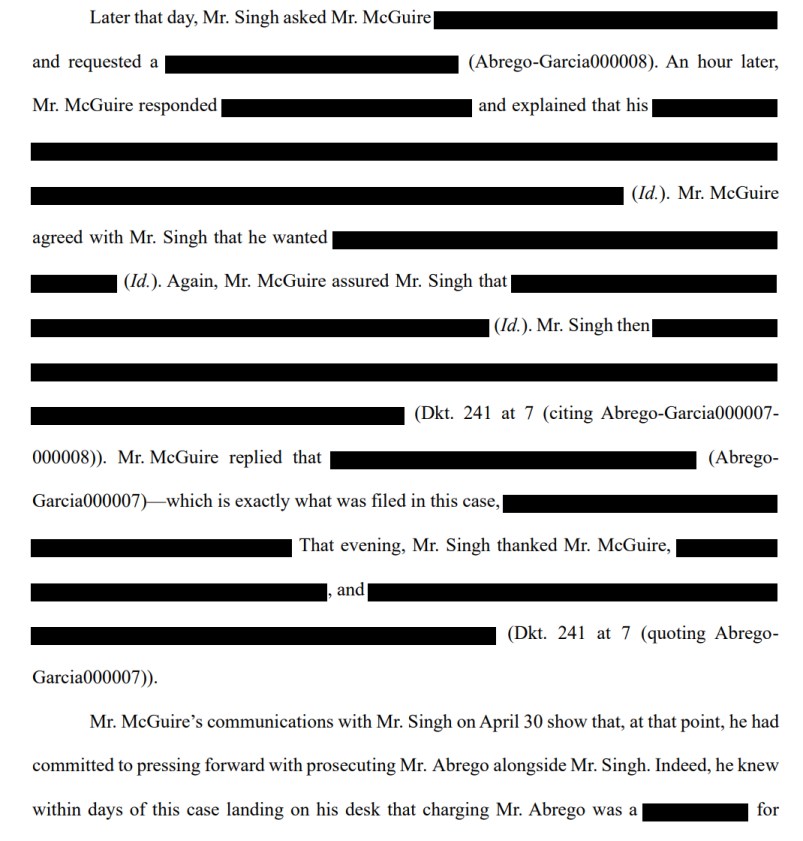
- We may not have to take Abrego Garcia’s attorneys’ word for it entirely. While they cite to a sealed Dec. 3 order in the case from U.S. District Waverly D. Crenshaw Jr. a total of 13 times in the new filing, they redact what Crenshaw said in the order – except in one place. In a possible redacting oversight, they appear to quote the judge as saying in his order that Singh had a “leading role in the government’s decision to prosecute”:
Despite the government’s brazen efforts to mislead the Court, the answer to this question is now obvious: this case landed on Mr. McGuire’s desk because Mr. Blanche’s deputy, Mr. Singh, who we now know had a “leading role in the government’s decision to prosecute,” placed it there. (Dkt. 241 at 5)
Where does this leave us?
Big picture: Abrego Garcia argues that the evidence of vindictive prosecution is so strong that the burden now falls on the government to prove otherwise and since the government won’t produce documents or witnesses to rebut the vindictive prosecution claim, the case should be dismissed.
Smaller picture: If the judge won’t dismiss the case now, then in the alternative Abrego Garcia wants him to deny the Trump DOJ motion to quash the subpoenas and proceed to an evidentiary hearing on the vindictive prosecution claim where top officials will be forced to testify.
One additional note: Abrego Garcia’s attorney filed a separate motion late Friday seeking sanctions against CBP commander Gregory Bovino for comments he made to national news outlets calling Abrego Garcia an “alien smuggler,” a “wife beater,” and an “MS-13 gang member.” Bovino also attacked the judges in Abrego Garcia’s criminal and civil cases as “activist” and “extremist.”
Bovino’s public vilification of Abrego Garcia came after Judge Crenshaw had already issued a series of orders to clamp down on prejudicial out-of-court statements by the Trump administration in violation of court rules. In one such order, Crenshaw previously directed the administration to provide actual notice of his order barring extrajudicial statements directly to DHS employees involved with the Abrego Garcia case and those who are authorized to speak on DHS’ behalf.
Given Bovino’s comments, Abrego Garcia is seeking sanctions against the government, but first he wants the court to inquire into how this happened:
Before the Court can determine what sanctions are appropriate here, however, the government should be directed to disclose to the defense and the Court whether and how the prosecution provided Mr. Bovino with a copy of this Court’s Order, who gave Mr. Bovino authorization to speak about Mr. Abrego’s case and what guidance Mr. Bovino was given about those statements, and any and all communications between counsel for the government and Mr. Bovino or DHS regarding Mr. Bovino’s statements, including any attempts to obtain a retraction or apology.
That gets you fully up to speed on what has been a slow-moving case. I expect that most of the sealed proceedings and filings will made public sooner than later, at which point we’ll have a finer-grained understanding of the discovery fight, what the administration has revealed and continues to try to conceal, and where Judge Crenshaw has come down on the key issues. But the latest filing is the best window into this case that we’ve had in a few weeks.