Prime Only Members-Only Article

Fear, Greed, Civic Virtue and the Fall of the Elites

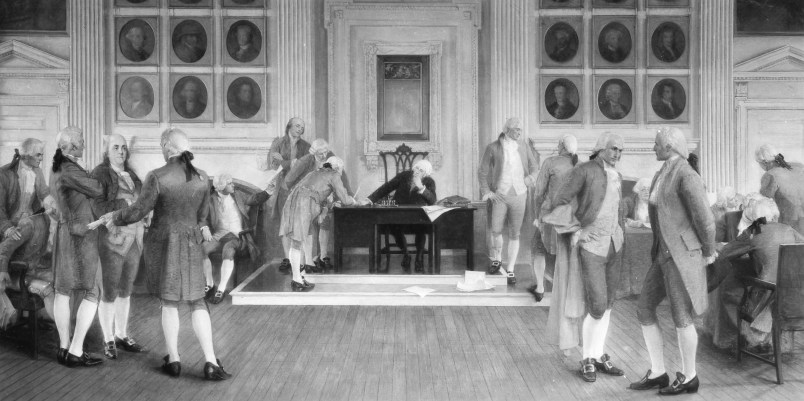
Painting, in the Wisconsin State Capitol, of 'The Signing of the American Constitution,' one of four mural paintings by Albert Herter on the west wall of the Supreme Court, Madison, Wisconsin, 1910. The scene represe... Painting, in the Wisconsin State Capitol, of 'The Signing of the American Constitution,' one of four mural paintings by Albert Herter on the west wall of the Supreme Court, Madison, Wisconsin, 1910. The scene represents American law, and depicts the signing of the Constitution of the United States of America in 1787 in Philadelphia, Pennsylvania, with George Washington presiding over the occasion. Washington is in the chair behind the table on a low dais. On the right in the foreground are James Madison, with a cloak on his arm, and Alexander Hamilton, standing. Farther back near Washington Thomas Jefferson is talking to another delegate whose back is turned. In the group of four men standing on the left in the foreground is Benjamin Franklin. (Photo by E. R. Curtiss/Wisconsin Historical Society/Getty Images) MORE LESS
|
October 24, 2025 1:43 p.m.
THE BACKCHANNEL
FREE EDITION
Your subscription could not be saved. Please try again.
Your subscription has been successful.
NEW!
A FREE email newsletter from Josh Marshall An email newsletter from Josh Marshall

Members of America’s founding generation had an ambivalent and evolving understanding of the role and importance of public or civic “virtue.” In the 1760s and 1770s, many of them were caught up in a kind of republican idea world which made this kind of virtue the cornerstone of any republic. The anchor of republican government wasn’t well-designed constitutions or legal accountability. It was the virtue of the free citizenry. By the late 1780s, many were developing a more pragmatic and jaded view of human nature and focused more on creating systems in which greed, the drive for power and other unlovely parts of human nature could be placed into some kind of enduring counterbalance. That was the basis of what became the federal Constitution and the driver especially for the two young ideologues, James Madison and Alexander Hamilton, both men in their thirties, who pressed the project forward.

I was thinking about this this morning when I saw a post by Leah Greenberg, the co-founder of Indivisible. She commented on the “utter moral failure of the elite of this country” when referring to a passage from an article by journalist Ed Luce who recounted talking to numerous leaders throughout the American power structure, all of whom said how critical it was for powerful public figures to set an example by speaking out and defying Donald Trump, and none of whom agreed to speak on the record.

Luce concluded by saying “it has felt like trying to report on politics in Turkey or Hungary.”

This got me thinking about the question of civic virtue.

This is a members-only article
Small Team. Big Results.
We’re proud of what our small newsroom has accomplished and it’s not hyperbole when we say that without our members, none of this would be possible.
Free memberships available for students and those experiencing financial hardship.
Already a member? SIGN IN