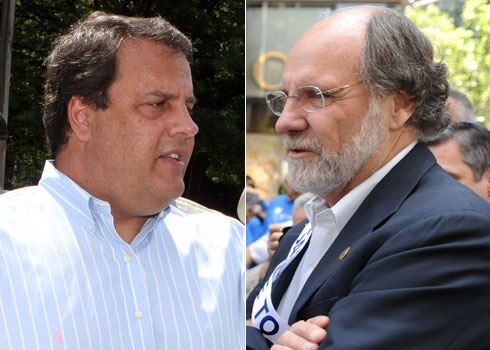
The three candidates for Governor of New Jersey — Democratic incumbent Jon Corzine, Republican Chris Christie, and independent Chris Daggett — met for a debate tonight, with a lot of substantive discussion on the issues facing the state. In a race marked by bitter personal attacks, this debate for the most part featured arguments about the issues themselves.
An interesting pattern emerged that when candidates fought each other, in almost all cases it was between Christie and another one of the participants. While Corzine and Daggett stated different positions on various issues, for the most part they didn’t take each other on directly. The real target of their attacks was Christie.
The most memorable exchange came when Daggett said to Christie: “I gotta buy you a calculator, Mr. Christie, because your numbers don’t add up. They never add up. You have no plan, no plan at all.” Daggett then said that he himself has a good plan on taxes and the budget, and he challenges anyone to come up with a better one that has real substance.
When it came time for Christie’s turn, he shot back: “I’m more than happy to take Mr. Daggett’s calculator. I’d like to give you a dictionary, because only you could take a $4 billion tax increase and call it a tax cut.”
When Corzine’s turn came again, he chimed in. “Let me agree with Mr. Daggett — Mr. Christie doesn’t seem to get the arithmetic right,” said Corzine, citing as one example how Christie said people are leaving the state, when in fact the population is growing. “It’s just misleading, talking down the state is not a great idea. In fact, we ought to have a positive view.”
Some more highlights, after the jump.
Daggett, a former state environmental official who originally came from a Republican background, tended to take a middle path between the other two candidates while condemning them for partisan excesses and negative campaigning. Christie gave a conservative critique of state policies on taxes and business regulation, while Corzine offered the most consistently progressive views.
Corzine had a frequent refrain, in response to Christie’s promotion of business tax cuts in order to spur job growth: “It’s more important to say we’re going to stand with the people of New Jersey on these issues, than to say we’re going to give tax cuts to the very wealthy or big business.”
At one point, Christie accused Corzine of attacking his weight: “So let’s just all let you in on a little secret in case you haven’t noticed over the last eight years that I’ve been in public life, I’m slightly overweight. Now apparently this has become a great cause of discussion in the state of New Jersey, so let me just lay it out for you — I am. Now I’ve struggled with it for a great part of my life, as I’m sure many of you have. And I’d like to know what that has to do with being Governor of the state of New Jersey.”
Corzine denied attacking Christie’s weight: “I don’t care about Mr. Christie’s weight. I do care about what matters for the people of the state of New Jersey.”
On the subject of gay marriage, both Corzine and Daggett said they would sign it into law if the legislature passed it. Christie said that marriage should remain between a man and a woman, and said that the state’s current civil union laws provide all the same necessary contractual rights that married couples have: “If the people of the state of New Jersey wanted to have same-sex marriage, I believe that ‘s something that should be put on the ballot, and let all of the people of New Jersey decide that. And of course if the people of New Jersey did decide that, that would be the will of the people.”
On immigration, all three candidates opposed deputizing local officials to enforce federal law. Christie and Daggett both said the federal government should do a better job of enforcement, while Corzine was more sympathetic than the others to illegal immigrants: “I get a little antsy when I hear the word ‘alien.’ I believe actually human beings aren’t aliens. They’re undocumented in the circumstances they are about.”
On the federal health care debate, both Christie and Daggett opposed a federal public option — Christie more forcefully so: “But if I were given the choice, I would not expand or opt into a public option. I would work to expand private options for folks.” Daggett also said that the current debates in Washington would not affect New Jersey very much, because the state already mandates coverage of certain preventive health care procedures, forbids denying coverage due to pre-existing conditions, and has other protections in place that are being debated in Congress.
Corzine seized on comments by Daggett that low-income people in New Jersey already have access to a state plan, in possibly their only moment of direct confrontation. “That’s exactly what the public option is, in New Jersey,” said Corzine. “You have just explained why we have reduced the number of uninsured 11%.”
The sparks flew again on the issue state-mandated coverage by insurance companies of mammograms, autism screenings and other preventive care — which the Corzine campaign has used as a major wedge issue against Christie, who has proposed legalizing mandate-free policies as a cheaper option.
Daggett was up first. “I believe, frankly, this mammogram issue is a lot more talk than anything else, because I believe most insurance companies would provide mammograms whether it was mandatory or not,” said Daggett. He made it clear that he has no problem with it being mandatory, but he also said that it’s in companies’ interests to cover preventive care in order to reduce costs of serious procedures down the road.
Corzine said that before the state mandated procedures, such as mammograms and autism screenings, the companies weren’t doing it: “There is no way that we should leave it up to the insurance companies, as Mr. Christie suggests, for mandate-free policies.”
Christie defended himself on what his proposal means. “So let’s be really clear about what my proposal is. My proposal is for the 1.4 million people in New Jersey that have no health insurance. If you don’t have health insurance, you’re not covered by any mandate.”
“This is a personal issue for me,” he added, talking about how his own mother was diagnosed with breast cancer at age 47, with the early diagnosis saving her life for another 20 years: “Near death sentence in 1980 — she survived. I would not let any woman not have that same opportunity.”
Towards the end of the debate, on the subject of corruption, Corzine did make a direct personal attack against Christie: “But I’ll tell you what we do not do, we do not give out no-bid contracts. That’s exactly what Mr. Christie said was the source of corruption in New Jersey — then turned around and gave seven no-bid contracts to his friends, who later gave contributions to his campaign. I believe that’s what’s called pay-to-play.”
The candidates closed with Corzine arguing that he stands with the people of New Jersey and not wealthy business interests, Christie posing the Reaganesque question of whether New Jersey has improved in the last four years, and Daggett calling on the people of New Jersey to stand up to the two-party system. So which will it be in two and half weeks — when the people finally vote?
(ed. note: The quotes used are rush transcriptions, and may be subject to later editing.)