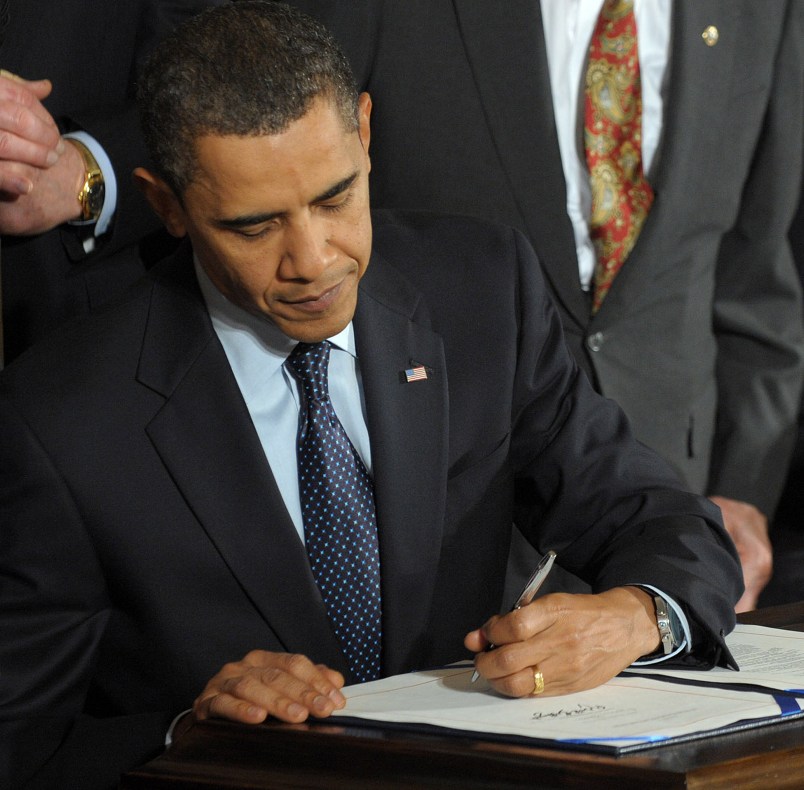
The White House this morning released a list of people who will attend President Obama’s signing of the health care reform bill in the East Room at 11:15 this morning. Here are the names, via the pool reporter:
Vice President Biden will introduce the President. The following individuals are to join Obama at the signing table:
Vicki Kennedy
Connie Anderson
Ryan Smith
Marcelas Owens
Secretary Sebelius
Senator Reid
Senator Durbin
Senator Baucus
Senator Harkin
Senator Dodd
Speaker Pelosi
Representative Hoyer
Representative Clyburn
Representative George Miller
Representative Waxman
Representative Levin
Representative Dingell
REMARKS ON HEALTH INSURANCE REFORM
Department of Interior
The President will make remarks celebrating the passage of the Patient Protection and Affordable Care Act. He will be introduced by the Vice President. The audience of approximately 600 people is comprised of health care advocates, doctors, nurses, Americans with health care challenges, members of Congress, administration officials and members of the cabinet. Joining him on stage will be: (bios below)
Vicki Kennedy
Connie Anderson
Marcelas Owens
Ryan Smith
Also in the audience at the Department of the Interior are the following individuals who wrote letters to the President about their health care challenges: (bios below)
Dawn Stone
Karen Kirtland
Bill Groome
Kenneth Scott
David and Lauren Gallagher
STAGE PARTICIPANTS BIOS
Vicki Kennedy
Vicki is the founding President of Common Sense about Kids and Guns, a non-profit, non-partisan organization that works to reduce gun deaths and injuries to children in the United States. She also serves on the Board of Trustees of the Brady Center to Prevent Gun Violence, where she is the chair of the National Advisory Committee and past chair of the Board’s Program and Strategic Planning Committee. She has served on the Board of Stop Handgun Violence in Boston, Massachusetts and on the Advisory Committee of the Annual Day of National Concern about young People and Gun Violence.
Vicki has been a guest lecturer at the American University Washington Semester Program, highlighting the public policy issues surrounding gun violence prevention and encouraging college students to become involved in their communities. She speaks and writes about gun violence prevention and other issues that affect the lives of women, children and families, such as homelessness, economic opportunity, health care, education, domestic violence, and involvement in the political process. In 1994, 2000, and 2006 Vicki played an active role in the re-election campaigns of her late husband, Senator Edward M. Kennedy (D-MA). She created a Massachusetts Women’s Council which has served as a model for other campaigns around the country, and she remains active in her support of candidates in Massachusetts and around the country. She was a National Co-Chair of the Obama National Catholic Advisory Committee. Vicki practiced law in the private sector until 1997, with a special emphasis on bank regulatory and commercial law and corporate strategic planning. She received a BA, magna cum laude, from Newcomb College in 1976 and a JD, summa cum laude, from the Tulane Law School in 1979. She then served as a law clerk for Judge Robert Sprecher of the U.S. Court of Appeals for the Seventh Circuit. In 1998, Vicki received an Honorary Doctor of Laws degree from the Suffolk University Law School in Boston for her service to her community. Together, the Kennedys have five children and four grandchildren.
Connie Anderson (Seville, OH)
Connie Anderson is Natoma Canfields sister. On December 29, 2009, Natoma Canfield wrote the President a letter describing her struggles with the rising cost of health insurance and how she could no longer afford her health insurance policy because of a recent exorbitant rate hike by her insurance company. In 2009, her insurance company increased her premiums by over 25 percent. When she learned that her monthly premiums in 2010 would again increase, this time by 40 percent, she could no longer afford her health insurance and had to drop her coverage altogether. Natoma wrote that because she would be uninsured, she was afraid that she would now be one unexpected health emergency away from losing her family home, which her parents built in 1958. She urged the President to stay focused on health reform because she and others are in desperate need of help. The President read and personally responded to Natomas letter, and he shared her letter during a recent meeting with the heads of the nations largest insurance companies, where Secretary Sebelius asked them to justify their recent rate increases. Two weeks ago, Natoma collapsed, was takento an emergency room, and has since been diagnosed with Leukemia. Natoma and her family are struggling to determine how they will afford Natomas medical treatment now that she no longer has insurance, which she dropped in January 2010 because of the rate hike. Under health reform, insurance companies will be held accountable to prevent insurance industry abuses, and Natoma could have access this year to a temporary subsidized high-risk pool for uninsured Americans with premiums that would not be based on her health condition. As well, under reform, Natoma will have access to affordable health insurance through Medicaid or in the new health insurance exchange, where she could qualify for tax credits to help her purchase coverage.Her insurance will also include important consumer protections such as no annual or lifetime limits and no rescissions. Unlike todays insurance market, under health reform insurance companies will not be able to deny Natoma coverage based on a pre-existing condition.
Marcelas Owens (Seattle, WA)
In the past couple weeks, Seattle 5th grader Marcelas has become a nationally recognized spokesperson for health care reform in honor of his mother. She died because she didn’t get the health care she needed after she got sick, lost her job and her health insurance. The day after his 11th birthday, Marcelas headlined a press conference in Washington, DC with Senate leaders. Marcelas’ message to Congress was simple: “Finish health care reform. No other kid should lose their mom because they don’t have health care.” Marcelas’ mom, Tifanny, worked as a restaurant manager and had health insurance. In September of 2006, she got really sick. Her doctors struggled to diagnose her illness, and Tifanny worked as long as she could while getting more and more sick. She would sometimes miss work because she was too sick and eventually, she had lost so much work that she lost her job, and along with her job went her health insurance. Without health insurance, Tifanny faced a barbaric choice – put food on the table for her kids or go to expensive doctors appointments that, without her job, she could no longer afford. At one hospital stay, Tifanny was diagnosed with Pulmonary Hypertension, but because she no longer had health insurance she was not able to afford the ongoing proactive treatment that she needed to go to battle with a tough disease. According to the Pulmonary Hypertension Association, while many Pulmonary Hypertension patients go too long without an accurate diagnosis, some receive prompt, effective treatment and are able to manage their disease for 20+ years. In June of 2007, Tifanny died at the age of 27, leaving Marcelas and his two younger sisters without a mom. Marcelas shares his story as a way to continue his mother’s fight for health care reform and to ensure that no other kid loses their mom or someone they love because they don’t have affordable health care.
Ryan Smith (Turlock, CA)
On January 27, 2010, Ryan emailed a letter to the President. Ryan is a small business owner with five employees. He currently provides health insurance to his employees, but he is struggling with rising health care costs. Health care is currently his second largest expense after his payroll, and although he wants to provide health insurance to his employees, he anticipates having to drop his health insurance due to increased cost. Under health reform, Ryan could be eligible this year to receive a small business tax credit to help him offset the cost of providing health insurance to his employees. In addition, he will have access to many new affordable options in the new health insurance exchange.
LETTER WRITERS BIOS
Dawn Stone (Brooklyn, IA)
On September 10, 2009, Dawn faxed a letter to the President. After Dawn and her husband both lost their jobs, they were forced to choose between paying their mortgage or health insurance. They decided to drop their health insurance and hoped they would soon find work that provided coverage. Unfortunately, Dawns husband soon fell ill and was hospitalized, leaving them with significant medical debt initially totaling over $100,000. Insurance companies have denied both of them health care coverage on the individual market, for Dawns arthritis and her husbands heart condition. When Dawns husband recovered and found a new job that offered insurance, their plan would not cover benefits for her husbands pre-existing condition for 12 months. After being laid off from work and losing insurance again, they were able to get health insurance through COBRA with the American Recovery and Reinvestment Act premium subsidy. Health reform will end discrimination against Americans with pre-existing conditions. Dawn and her husband will have access to affordable options in the health insurance exchange, as well as out-of-pocket limits to save them from future exorbitant medical debt.
Karen Kirtland (Riverside, CA)
On March 20, 2009, Karen mailed a letter to the President, which he read and responded to. Karen is a self-employed small business owner. Since purchasing her health insurance plan on the individual market in 1999, she has been diagnosed with high blood pressure, high cholesterol, and asthma. Her current insurance company told her that if she ever reapplied, they would deny her coverage based on these pre-existing conditions. Because of these conditions, she has felt trapped in her current insurance company. In her March 2009 letter to the President, Karen wrote that she was fearful she would have to choose between paying her mortgage or paying her health insurance. Since then, in 2010, her insurance company increased her rates by 20 percent to $1,327 per month. In order to afford her health care, Karen switched to a plan with her insurance company that costs $731 per month, but she now has a much higher deductible and co-pays than before. Under reform, Karen will have more options for her health insurance through a new health insurance exchange, where all of the plans will include important consumer protections such as out-of-pocket limits and limits on annual and lifetime limits. Reform will end discrimination against Americans with pre-existing conditions. As well, reform will create a grant program to support States in requiring health insurance companies to submit justification for requested premium increases, and insurance companies with excessive or unjustified premium exchanges may not be able to participate in the new health insurance exchanges.
Bill Groome (Asheboro, NC)
On November 4, 2009, Bill faxed a letter to the President. Bill wrote that in late December 2008, at age 63, he became unemployed when his employer went out of business and for the first time in his life found himself without health insurance. His wifes employer does not offer insurance at work, and they were able to purchase a plan on the individual market for just over $800 a month. Ten months later, Bill received a notice that his monthly premium would increase by over $100 a month effective January 2010. Their monthly insurance is as much as their mortgage payment, and they are not sure how their will afford the payments once Bills unemployment insurance ends. Bill wrote that he had been planning to have a routine colonoscopy in early December 2009, but he was shocked to learn from his health care provider that he would have to pay $3,000 out-of-pocket for the procedure. Bill did not have the colonoscopy because he could not afford it. Under health insurance reform, Bill and his wife will have access to affordable options in the health insurance exchange and could qualify for tax for credits to help them purchase coverage. In addition, within 6 months, new plans will be required to offer preventive services, including colonoscopies, with no cost-sharing, and plans in the health insurance exchanges will also offer these benefits with no cost-sharing.
Kenneth Scott (Poneto, IN)
On December 15, 2009, Kenneth faxed a letter to the President. Together, Kenneth and his wife own and operate a family farm and find themselves strugglingwith the cost of health insurance. After his wife left her work as a medical professional to help out on the farm ten years ago, they lost their health insurance coverage through her work. When they applied for health insurance on the individual market, his wife was denied coverage for potential medical problems. They were able to get small group coverage, and they have recently faced steep premium increases. After facing a rate increase in September 2009, Ken and his wifes premium increased again in January 2010 by almost $1,000, to $2,910 a month. Although they struggle to afford the monthly premiums, Ken wrote that he fears that if they did not have insurance, they could be one catastrophe away from having to sellassets from the family farm and wiping out their livelihood. Since getting insurance 10 years ago, Ken has now developed high blood pressure and cholesterol, and he and his wife have not been able to find other health insurance options. Health reform will end discrimination against Americans with pre-existing conditions, and Ken will have affordable health care options in the new health insurance exchange. As well, reform will create a grant program to support States in requiring health insurance companies to submit justification for requested premium increases, and insurance companies with excessive or unjustified premium exchanges may not be able to participate in the new health insurance exchanges.
David and Lauren Gallagher (Oxford, PA)
On July 3, 2009, Lauren, a 17 year old high school student, mailed a letter to the President, which he read and responded to. In her letter, Lauren wrote that when her mom lost her job the previous August, her family of five lost their health insurance as well. The family did not qualify for the American Recovery and Reinvestment Act COBRA premium subsidies because her mom lost her job a week before the eligible date, and the family eventually had to drop this coverage because they could not afford the monthly premiums in addition to the mortgage and their other daughters college tuition. When the family tried to get coverage on the individual market, the insurance company denied her father David coverage because of a previous complication-free hernia surgery. David is currently uninsured, and Lauren wrote that she is fearful what might happen if her father became sick or injured. Under health reform, the entire family will have access to affordable health insurance options in the new exchange, and they could be eligible for tax credits to purchase their coverage. Reform will end discrimination against Americans with pre-existing conditions. As well, David could have access to health insurance this year through a temporary subsidized high-risk pool for uninsured Americans with pre-existing conditions.