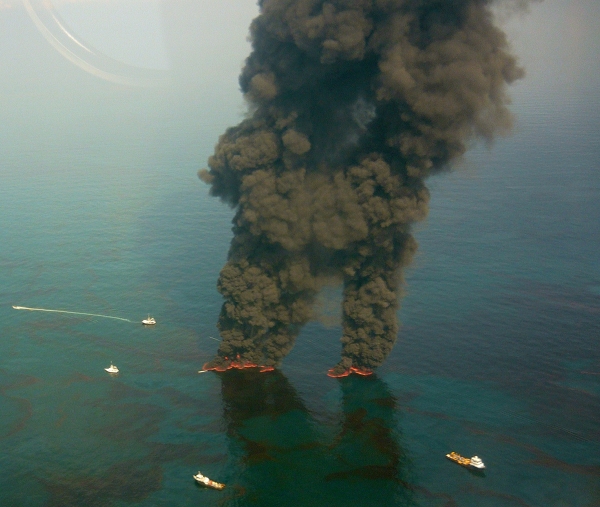
Earlier this month, we told you how the National Marine Fisheries Service, charged with protecting endangered marine life in the Gulf, drastically underestimated the size and effects of an oil spill in the Gulf. Its opinion allowed the government to sell leases to oil reserves in the Gulf — including the now-leaking Macondo well — to various oil companies.
Fisheries estimated that a “major” oil spill would be about half the size of the Ixtoc I disaster, which dumped an estimated 3.5 million barrels in the Gulf of Mexico in 1979.
TPMmuckraker has now found proof that Fisheries did little more than throw up their hands and guess when coming up with that estimation. But the former Minerals Management Service did much worse, estimating that such a spill would be about 15,000 barrels — less than one percent of Fisheries’ estimate.
“With new technologically advances [sic] and oil spill prevention and response plans, a major oil spill in the GOM [Gulf of Mexico] would not likely be as large as Ixtoc I (Minerals Management Service 2006). In the following analysis we use one-half estimates of the approximate maximum spill area from Ixtoc I to estimate potential impacts from a major oil spill occurring as a result of the proposed action,” reads Fisheries’ 2007 report on the proposed lease sales.
The report concluded that the drilling wouldn’t have much effect on the Gulf’s endangered species, while at the same time saying that a spill half the size of the Ixtoc could decimate the adult sea turtle population and halve the juvenile population.
The current spill has far surpassed that number and had, by AP’s estimates, already leaked more oil than the Ixtoc did as of July 1.
The director of Fisheries’ office of protected resources, Jim Lecky, told us today how his agency came up with the half-Ixtoc number:
“According to the author of the biological opinion, the size of the spill is based on the fact that MMS believed that a spill like the Ixtoc spill, couldn’t happen again, due to all of the advanced technology,” Lecky told TPMmuckraker in an email.
“However, NOAA felt that it was not out of the realm of possibility that a large spill could happen, but with the new tech to control spills, we felt it wouldn’t be as bad as Ixtoc,” he said. “So, we thought we were being conservative by saying 1/2 the size.”
Earlier, Lecky mentioned that Fisheries has to rely on other agencies for the technological expertise in a given field. In this case, he said, Fisheries relied on MMS (now the Bureau of Ocean and Energy Management) for information on oil drilling tech.
MMS never said, to our knowledge, that a major spill in the Gulf could clock in at half the Ixtoc. But to Fisheries’ credit, MMS guessed that big spill would be just 15,000 barrels.
That’s less than one percent of Fisheries’ estimate.
MMS based its prediction on the median size of spills, greater than 10,000 barrels, that occurred between 1985 and 1999. There were only two such spills, pumping a total of 30,000 barrels of oil into the ocean.
The 2007 environmental impact statement, prepared by MMS as part of its proposed lease sale, explains why:
From 1985 to around 1995, OCS [outer continental shelf] production was on the order of a third of a BBO [billion barrels of oil] per year. Since around 1995, OCS production has been more on the order of half a BBO or more. The pipeline spill rate has been pretty consistent over time. Platform spill(s) â¥1,000 bbl from Hurricanes Katrina and Rita is the first since 1980, which is a huge amount of production between spills. Therefore, MMS feels that the 1985-1999 spill rates, which are used for this EIS, are appropriate.
There were several bigger spills before 1985: an 80,000-barrel spill in 1969 (caused by a blowout), a 53,000-barrel spill in 1970 (caused by a fire) and a 30,000-barrel spill in 1970 (fire and blowout). Although they were noted in the assessment, they were not factored in to MMS’ estimates.