Updated October 14, 12:55 p.m. ET
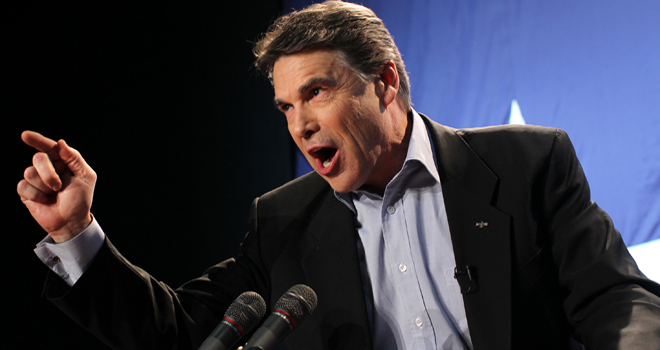
Rick Perry unveiled his campaign’s economic and energy proposals, dubbed “Energizing American Jobs and Security”, in a speech today in Pittsburgh, Pennsylvania. And as could be expected from a governor of Texas who has advocated mass devolution of various federal powers to the states, Perry is calling for heavy deregulation of the energy sector.
“You know what I’m proposing today is the first part of an economic growth package that’ll rebuild the engine of American prosperity,” Perry said. “And the plan that I present this morning, ‘Energizing American Jobs and Security,’ will kick-start the economic growth of this country, and create 1.2 million jobs.
“And it can be implemented quicker, and free of Washington gridlock, because it doesn’t require constitutional — or I should say, Congressional action. we’re doing it through a series of executive orders, and other executive actions. And we’ll begin the process of creating jobs, soon after the inauguration of a new president.
“This [sic] is of course an important role for Congress to play as well. In a matter of a few days I’m gonna offer to the American people a broader package of economic reforms that’ll require Congressional action when I’m elected President of the United States. But my complete economic growth package will tackle tax reform, and entitlement reform, and real spending reductions in order to address our growing debt crisis.
“But today, today I offer a plan that will create more than a million good-paying American jobs, across every sector of the economy, and enhance our national security. And the best news is, it can be set in motion in the first 100 days of my administration.
“And my plan is based on this simple premise: make what Americans buy, buy what Americans make, and sell it to the world. We’re standing on top of the next American economic boom, and it’s the energy underneath this country. And the quickest way to give our economy a shot in the arm, is to deploy the American ingenuity to tap American energy. But we only do — we can only do that if environmental bureaucrats are told to stand down.”
Perry said that under his plan, more federal government-controlled lands would be opened up for energy exploration. He criticized the Obama administration for a sharp slowdown in approval of offshore oil exploration and drilling, in the Gulf of Mexico and other areas of the country. (However, it should be noted that much of this slowdown was a reaction to the 2010 BP oil disaster in the Gulf of Mexico.)
His plan also calls for the states to take over more of the regulation and oversight of energy exploration, on the grounds that the states are closer to the people and the needs of the affected communities.
Toward the end of his speech, he said: “The choice this election is between two very different visions for our country. When it comes to energy, the President would kill domestic jobs through these aggressive regs — while I would create 1.2 million energy jobs through safe and effective energy development right here at time…His energy policies are driven by the concerns of activists in his party. My policies are driven by the concerns of American workers without jobs. We must get America working again, and a big part of the solution is right under our feet and right off our coast.”
Late Update: Obama campaign communications director Ben LaBolt responds:
“Governor Perry’s energy policy isn’t the way to win the future, it’s straight out of the past – doubling down on finite resources with no plan to promote innovation or to transition the nation to a clean energy economy. President Obama has pursued an energy strategy that has created hundreds of thousands of jobs in the clean energy sector, ensured that we’re using all domestic sources of energy in a responsible way to meet our current needs and strengthened our energy security by reaching an agreement on fuel economy standards that will save us from importing millions of barrels of oil from the Middle East. He doesn’t believe that we can settle for less when China is racing to capitalize on the clean energy market.”