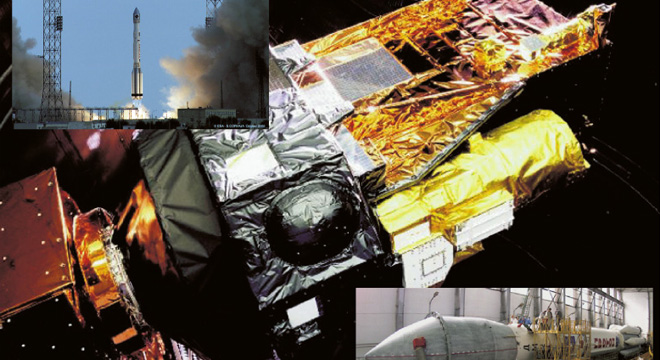
Another one bites the dust. Just under a month after a dead NASA climate satellite crashed harmlessly into the Pacific Ocean in an uncontrolled re-enry, a defunct German X-ray satellite is headed for much the same fate.
The Roentgen satellite, aka ROSAT, launched in 1990 by the U.S., was a collaboration between NASA, the British space agency and the Germany space agency. Having exhausted its fuel in 1997 and suffered permanent damage after pointing its camera directly at the sun in 1998, the defunct satellite continued to orbit the earth as a piece of space junk. Now in a decaying orbit, it is expected to re-enter the earth in an uncontrolled free-fall between Saturday, October 22 and Sunday, October 23, according to the German Aerospace Agency (via Space Policy Online).
This time, though, the odds of the satellite striking a person on the ground, anyone in the world, are greater: 1-in-2,000 compared to the 1-in-3,200 odds of the UARS satellite.
Although, as we saw in that case, those numbers are a bit misleading because they are reflective of 1 person being struck for every hypothetical 2,000 or 3,200 satellites that crash.
Instead, a more useful odds calculation is for the risk that the satellite will strike you personally. Multiplied by the number of people on earth (approximately 7 billion), the odds are drastically reduced, to about 1-in-14 trillion in the case of the ROSAT satellite.
Strangely, though, ROSAT was a significantly smaller and lighter satellite than UARS: 2.4 tons for ROSAT compared to about 6.5 tons for UARS. The reason the risk is greater this time is due to the fact that more of the ROSAT satellite’s mass is expected to survive re-entry, an estimated 1.7 tons, compared to UARS, in which under a ton of debris survived the re-entry.
“The fact that the ROSAT re-entry risk estimate is higher than for UARS lies in the surviving mass, which, percentage-wise, is considerably higher for ROSAT than for UARS, and hence, the net mass reaching ground is higher for ROSAT than for UARS,” Heiner Klinkrad, head of the European Space Agency’s Orbital Debris Office, told Life’s Little Mysteries, a sister site to SPACE.com. “This is due to the ROSAT internal mirror assembly that is very resistant to [heat] during re-entry.”
Again, though, as in the case of UARS, nobody – not NASA, not the German space agency – has a definite idea of where on Earth the satellite’s debris will end up, due to the fact that its fall is uncontrolled.
Various private or quasi-private aerospace companies are trying to track the satellite and offer updated projections of its likely re-entry path. The best source we’ve found, from monitoring UARS, is The Aerospace Corporation, which at the time of this posting, projects ROSAT to re-enter over South America, somewhere between Bolivia and Brazil, at 5:33 am ET, plus or minus six hours. This is highly subject to change.
Meanwhile, amateur astrophotographer Thierry Legault, an engineer by profession, has again managed to capture several images of the satellite in orbit, using his own home-rigged telescope equipment on the ground.
Check out his latest, taken on October 16:
More background on the satellite: For ROSAT’s first six months, it conducted an X-ray survey and extreme ultraviolet survey of the entire sky. After that, it switched to a “pointed observation” mode, focusing on specific objects, including comets, discovering that some emit X-rays, according to Universe Today. In 1994, after four years of operation (long beyond the 18-month lifespan originally predicted), the satellite was shut off to conserve fuel, NASA notes. Several additional projects were carried out in late 1998 and early 1999, but in 1998, the satellite’s star-tracker suffered a fatal error, pointing the satellite’s camera at the sun, frying it, according to SPACE.com.
TPM will continue to update as the satellite approaches re-entry. Stay tuned.