The answer is out there…somewhere.
Scientists at the European Organization of Nuclear Research (CERN) on Tuesday morning put an end to two weeks of fervent speculation about whether or not they caught a glimpse of Higgs-Boson, the much-sought “God Particle,” releasing an inconclusive new update about their research. In short, CERN saw something interesting, but it isn’t sure if it’s Higgs-Boson — yet.
“Over the last few weeks we have started to see an intriguing excess of events,” explained Fabiola Gianotti, a spokesperson from CERN’s ATLAS experiment, one of the six experiments running on CERN’s Large Hadron Collider, the world’s largest particle accelerator.
Gianotti continued: “This excess may be due to a fluctuation, but it could also be something more interesting. We cannot conclude anything at this stage.”
CERN’s Large Hadron Collider, a $9 billion, 17-mile long ring below ground near Geneva, Switzerland, was designed specifically to search for the elusive Higgs Boson — a theoretical particle that would explain why any object in the universe has mass under the Standard Model of particle physics, scientists’ best guess for how the universe works.
If the Higgs Boson cannot be found by the LHC, scientists will have to throw out that theory and move to other, more obscure ones.
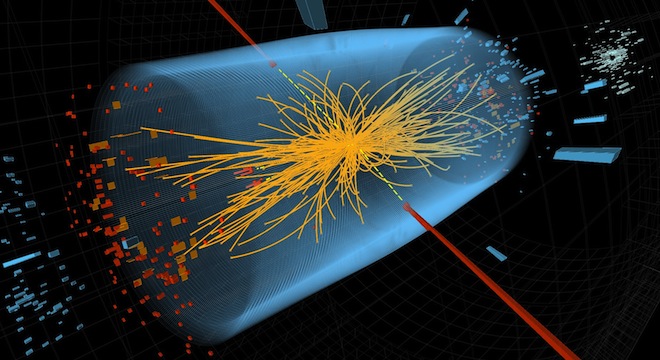
The Large Hadron Collider attempts to create a Higgs Boson by smashing two high-energy beams of protons together and analyzing the resulting “debris,” or particles that result from the collision. Unfortunately, these particles have very brief half-lives, and quickly decay within fractions of a second, so CERN must rely on highly-sophisticated snapshots of the period immediately after the collision in order to conduct particle detection.
Still, although CERN can’t say yet for certain without more refined analyses (which are underway) whether or not what it is seeing is the Higgs Boson, the scientists have narrowed the window for where it would briefly appear in the Large Hadron Collider: The Higgs Boson would have a mass between 116 and 130 gigaelectronvolts (a standard measure of particle physics, with 1 gigaelectronvolt, the mass of 1 proton, equivalent to 1 billion electron volts) according to CERN’s ATLAS experiment, or between 150 and 127 gigaelctronvolts according to CERN’s CMS experiment.
CERN expects to have more conclusive findings to present at a series of particle physics events in March. Until then, the mysteries of the universe will remain unsolved.