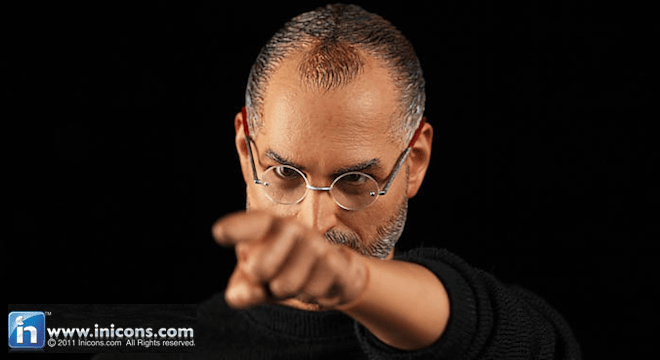
An action figure of Apple’s late founder and former CEO Steve Jobs being sold by a Chinese company can be legally sold in most parts of the U.S., despite Apple’s reported threats to sue over the likeness, according to PaidContent.
Apple had reportedly sought to intimidate the company, In Icons, into giving up its efforts to market and sell the uncannily realistic Steve Jobs memorial figure (with 14 points of articulation!) by sending the company a cease-and-desist letter, as the UK media outlet The Telegraph wrote in a piece filed from Los Angeles on Thursday.
A day prior, apparently anticipating a challenge, In Icons’ CEO struck a preemptively defiant tone, telling ABC News:
“Apple can do anything they like,” In Icons’ Tandy Cheung said. “I will not stop, we already started production.”
As it turns out, In Icons apparently had good reason to be unrepentant in its efforts to memorialize Jobs and make some bucks: As Paid Content‘s Jeff Roberts reported on Friday:
“Apple’s legal claim is largely bogus. While people can indeed own rights to their likeness, those rights usually apply only to living people. Unlike other forms of intellectual property like patents or copyrights, image rights do not survive beyond the grave in most places.”
Roberts explained that in the U.S., so-called “personality rights” — the rights to the likeness of a famed person’s image — should restrict the figure from being sold in only 16 states. However, among those states include some of America’s largest and most populous cities. The full list includes: Indiana, Illinois, Texas, Connecticut, Georgia, Florida, California, Ohio, Virginia, Washington, New Jersey, Nevada, Nebraska, Kentucky, Tennessee and Oklahoma.
Moreover, as Roberts alleges, the name “Steve Jobs” has not been listed as trademarked by Apple, either.
However, the PaidContent report only glancingly references international copyright laws, which would seem to be the main issue in this case, pointing out that Germany and Argentina have posthumous image rights’ protection.
Apple would presumably seek to bring action against the Chinese company through its Asian division. But in China, and specifically, in Hong Kong, the situation is further complicated. As Meryl H. Wang, an attorney at international intellectual property law firm Kangxin Partners, wrote in the October/November issue of trade publication World Trademark Review:
There is no clear definition of “image rights” in Chinese law and most illustrations of image rights are influenced by other countries’ definitions…
In practice, Chinese law offers protection for portrait rights, which are similar to image rights.
Article 100 of the General Principle of Civil Law of the People’s Republic of China stipulates that every citizen has portrait rights and that his or her portrait cannot be used for commercial purpose without his or her permission…
These provisions clearly establish that name and image rights are protected under Chinese law, and that the image of a person cannot be used commercially without that person’s permission. However, as portrait rights still fall within the doctrine of personality rights, which are designed to protect a citizen’s interest in privacy, portrait rights cannot fully cover the regime covered by image rights…
But in the relatively autonomous region of Hong Kong the laws are substantially different, and celebrities such as Jobs would face an extraordinarily difficult, even hostile legal climate in attempting to bring legal action over personality rights. As Drake University law professor Peter K. Yu, wrote in a paper published in September 2010:
“Hong Kong offers only very limited protection to celebrities’ identities…To complicate matters further, personality rights face the same challenge as the protection of luxury goods. It is, indeed, hard for celebrities to earn public sympathy when they complain about the harm they have suffered through the misuse of their identities.”
In other countries, In Icons would seem to be in the clear. There is no such thing as “international copyright,” as the U.S. Copyright Office points out. Instead, there are two major international agreements that govern copyright disputes between member nations: The Berne Convention and the Universal Copyright Convention (UCC), but both of these are primarily concerned with the authorship and creatorship of works, extending posthumous rights to creators, rather than personality rights.
In Icons is offering the Steve Jobs memorial figure for sale in “United State [sic], Europe, Asia, and Other Countries.” We’ve reached out to In Icons and Apple for more information on the reported dispute and will update when we receive a response.