LAS VEGAS — Apple won’t be missed at the 2012 Consumer Electronic Show (CES), at least according to the chief economist of the event’s organizing body.
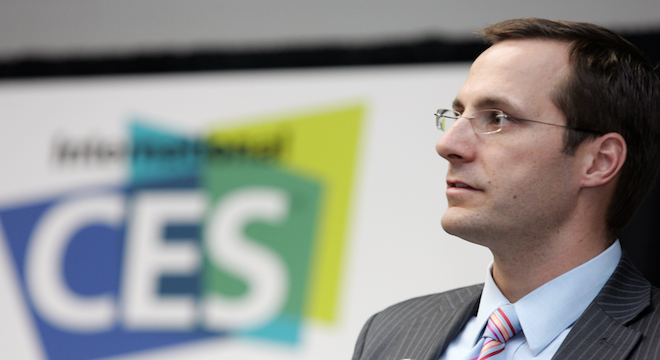
Shawn DuBravac, chief economist and director of research with the Consumer Electronics Association (CEA), which hosts the annual, week-long international gadget parade, started the 2012 show off with a bang during his State of the Industry speech on Sunday night — taking aim at those gadget writers and Apple fans who demean the show’s importance by pointing out Apple’s longstanding absence.
“I always read 30 plus articles heading into CES about how Apple is not presenting,” DuBravac told a crowd of reporters and analysts overflowing out of a cramped conference room at the Venetian hotel. “To me, that’s not the big story.”
Instead, DuBravac said that the big story was more about the overall trend in the industry toward creating gadgets that offered “natural” i.e. intuitive controlled experiences to the user. DuBravac said this was evidenced in the explosion of touchscreen smartphones, tablets, apps and other touch and gesture-controlled gadgets over the past several years, a trend he said would only continue to pick up steam in 2012.
DuBravac even went so far as to proclaim 2012 the “Year of the Interface,” based on his projection that all of the gadgets unveiled at CES — including 30 to 50 ultrabooks (ultra-thin laptops), over 50 tablets, and over 100 smartphones, not to mention countless large-screen TVs and other high-tech toys — would feature more refined, easy-to-use controls and menus for navigating the Web.
The CEA econ chief’s presentation included a number of flashbacks to gadgets of yore to illustrate his points — perhaps none more potent than the reminder that at one point, Zenith used to make a TV remote attached to the actual set by a physical cord. However laughably anachronistic that may now seem, DuBravac noted that the 4-button “Lazy Bones” Zenith remote was in some ways superior to the tech we’ve gotten used to over the past few decade, bringing up a slide of a modern remote with 40 buttons.
“If you’ve ever tried to check your email on a 50 inch TV, you’ll know it’s an unpleasant experience,” DuBravac said.
But, he said, it was illustrative of the general cycle of technology advancement: From “birth to complexity,” back to “simplicity” and finally to “natural experience.”
DuBravac noted new TVs being showed off at CES 2012 — including an Android-based Lenovo set — were making huge leaps toward this goal. He also held out hope for a Google TV with Google web search seamlessly integrated into the channel finder, as well as thinner, bezel-less models.
“The next decade of the digital transition is all about pulling together all of the digital assets we’ve accumulated, all of our content,” DuBravac explained, “So we can organize them and search them.”
DuBravac also sought to downplay the tension between Google’s “open source” model and Apple’s “walled garden” approach when it came to their mobile operating systems (Android and iOS), saying “Open and closed platforms don’t really matter. What matters is that they are ‘open enough,'” both allowing developers the chance to build apps — and related hardware — using the powerful operating systems.
And just to give the tech analysts one more thing to talk about, DuBravac attempted to beat back the rising consensus that nobody wants a stereoscopic (no goggles) 3D TV set, saying that it was an innovative technology that just needed more time to become a commercial success.