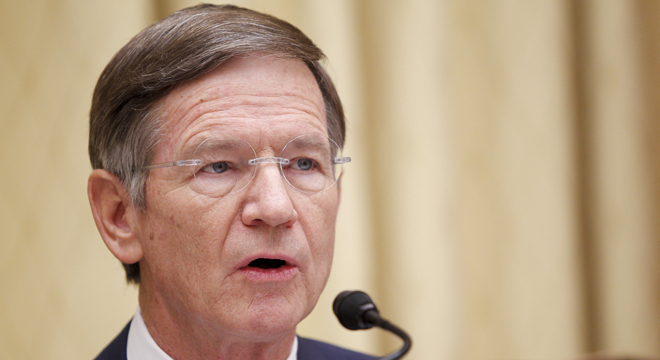
Rep. Lamar Smith (R-TX) late Wednesday acknowledged that the mass online protests against his anti-online piracy bill were causing formerly supportive lawmakers to flee in droves, but said that he was confident that “facts will overcome fears,” and vowed to continue working on “strong legislation” to combat online piracy.
Smith is the architect of the Stop Online Piracy Act (SOPA) and the Chairman of the House Judiciary Committee, which is in charge of marking the bill up — voting on amendments to it — before it is taken to the full House for a vote.
Smith introduced SOPA to the House in October. Like it’s sister in the Senate, the PROTECT IP Act (PIPA), SOPA would allow the U.S. Attorney General to seek court orders to force the takedown of foreign websites accused of piracy based on the accusations of copyright holders, including Hollywood and the recording industry, which, not surprisingly, have come out strongly in favor of the legislation.
But many Web companies are increasingly opposed to the bills — including Google, Wikipedia, Facebook and Twitter — arguing that the language is written so broadly that it could potentially sweep-in U.S. websites or parts of U.S. websites and would impose undue burdens on them to police their users for linking to pirated content.
Upwards of 7,000 websites blacked out their content or altered their homepages for American users on Wednesday in a mass day of protest against the bills. The protest was started by Reddit.
Smith, though, said that all of the hullabaloo was for nothing. As his statement released Wednesday night reads:
“I realize some people are nervous because of misinformation about this bill, but I am confident that ultimately the facts will overcome fears. We will continue to work with members, outside organizations and stakeholders to reach consensus and produce strong legislation that protects both intellectual property and technology.
“Contrary to critics’ claims, SOPA does not censor the Internet. It only targets activity that is already illegal, and only targets foreign websites that steal and sell America’s technology, inventions and products. And it is similar to laws that already govern websites based in the U.S.
“I am open to constructive suggestions that protect American inventors and intellectual property rights holders. Unfortunately, some critics simply want to maintain the status quo which harms U.S. companies, consumers and innovators. Illegal piracy and counterfeiting cost the U.S. economy $100 billion and thousands of jobs every year. Congress cannot stand by and do nothing while some of America’s most profitable and productive industries are under attack.
“We need strong and effective legislation to protect American technology and put foreign thieves out of business. I will continue to work to address legitimate concerns and encourage members and stakeholders to provide substantive recommendations for how best to address the problem of online theft.”
Earlier on Wednesday, Senator Patrick Leahy (D-VT), the principle sponsor of the PROTECT IP Act, posted a release of his own designed to address the critics’ complaints that his bill’s language was too broad.
Taking critics line-by-line through the definitional sections of PIPA, Leahy endeavored to point out just how his bill would not sweep in Google, Wikipedia, Twitter or other similar websites that rely on user-generated content. As Leahy’s release read:
“Websites like Wikipedia, YouTube, Flickr, Twitter, Google, craigslist, eBay, The Huffington Post and Yahoo! do not meet the definition of a website ‘dedicated to infringing activities,’ and the PROTECT IP Act does not reach websites where only a sub-domain is dedicated to infringement.
“While some sub-domains generated from these top-level domain names do host infringing content, and may even be dedicated to infringing content, the top-level domain and its sub-domains cannot be “taken down’ as opponents suggest because the entire website must be dedicated to infringing activity.”
However, as TPM pointed out earlier when examining the legislation, it does not appear that there are any formal mechanisms in place in either SOPA or PIPA that would provide formal protection for such websites from copyright-infringement complaints or the private right to action (separate lawsuits from those copyright holders).
Quite the contrary, while SOPA does provide a “good faith” exception for certain companies that comply with it — including advertisers, payment processors and domain registrars like GoDaddy.com (which helped to draft the legislation), there are no other exceptions in the language that we can see, and we’re not the only ones.