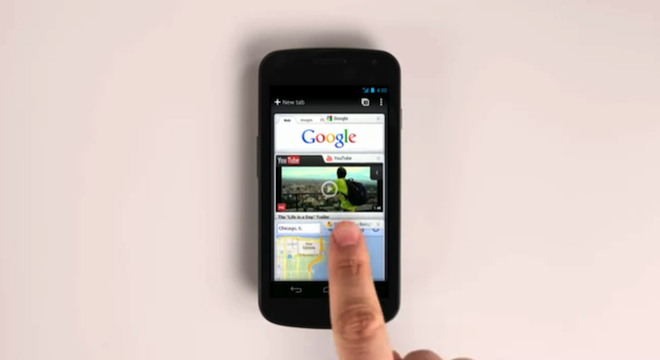
Google’s not pulling any punches in the browser wars. On Tuesday, the company announced it was bringing its increasingly popular Chrome Web browser to mobile phones and tablets, albeit in a beta form, and only for devices running Android Ice Cream Sandwich (version 4.0 or higher).
Android 4.0 users can download it now for free in the Android Market.
“We’re excited that millions of people around the world use Chrome as their primary browser and we want to keep improving that experience,” wrote Sundar Pichai, Google’s senior VP of Chrome and apps, in a blog post announcing the new version of the browser.
The company also posted the following short ad for the new product:
The mobile browser’s new features include; “seamless sign-in and sync” with the desktop version of the browser, allowing users to preserve open tabs immediately when closing their computers and picking up their phones; new mobile-specific browser tabs, which Google likens to flipping through a deck of cards; and auto-zoom on links, which Google says will eliminate the annoyance of hunting for and pecking tiny links on a smartphone screen.
True to the desktop version, the mobile Chrome also offers predictive typing technology, but takes this a step further, completely loading a likely web page in the background based on a user’s entry into the browser address bar (what Google calls the “Omnibox” on Chrome). For instance, for a user typing “y” who had often visited YouTube, Chrome mobile will load the full YouTube page in the background.
However, this feature is only turned on by default when the phone is connected to a WiFi network to preserve bandwith and avoid pesky data limits. Users can adjust the settings on the browser themselves, as Chrome’s engineers explain in the following video (made for developers).
As far as privacy concerns go — since that’s been a big issue for Google as of late — the new browser does seem to take advantage of nearly all of a mobile user’s device data — from GPS location to currently running apps to log data, “potentially including personal or private information,” to even audio calls.
Google is upfront about all of this, explaining it in the “permissions” section of the browser on the Android Market, but is markedly more information than is being collected by competing mobile browsers available for Android devices — including Mozilla Firefox and Opera Mini. It is similar to the amount of information being collected by the Dolphin HD browser.
Intriguingly, one feature that really stands apart is that Chrome for Android alone among competing browsers says it will take advantage of “near field communication” technology or NFC, the radio data transmission service that Google uses to power its Google Wallet wireless mobile payment system. It’s unclear at this time whether or not the Chrome for Android NFC permissions has to do with Google Wallet or something separate.
So far, the initial reviews for Chrome for Android are overwhelmingly positive, with 491 “5 star” ratings in the Android app store and an average rating of 4.3 from 781 reviews. Still, some commentators have been pointing out the beta’s shortcomings, including the lack of Flash multimedia support:
“No option to request a desktop view and no flash support are things that will make me uninstall this app,” wrote one user, zeiroe.
“Looks good but it infuriates me when browsers don’t offer an open as desktop version option,” added another user, Neil.
“Are there any plans to make this app compatible with pre-[Ice Cream Sandwich] devices?” asked another user, Phillip, on Google’s blog.
All good points that Google will certainly have to address if it wants to turn Chrome into the default mobile browser. Android phones currently ship with a default Android Webkit browser, while iOS devices use a mobile version of Apple’s Safari, though it is highly unlikely (read: never gonna happen) that Apple would allow Chrome onto the iOS as an app. Globally, Safari for iOS leads on mobile devices with a 55 percent market share, with Opera Mini a distant second at 20 percent, according to the latest numbers from tracking firm Net Applications.