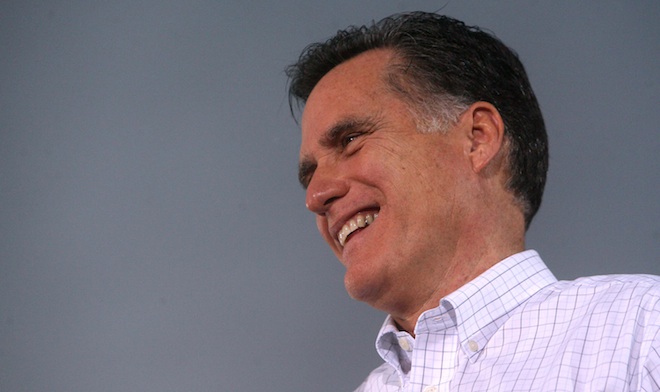
CPAC — By slim majorities, Mitt Romney won the CPAC straw poll Saturday as well as a national poll of conservatives sponsored by the organizers of the massive conservative conference.
So does that mean Romney has rekindled his connection with conservatives after earlier losing three primaries to Rick Santorum in one night?
Well, not exactly. CPAC had its ups and downs for Romney, the man who still struggles with his conservative credentials.
The surprising poll wins were certainly an up — but it’s worth remembering that while Romney beat Rick Santorum by seven points in the straw poll (which was an unscientific survey of around 3,400 attendees at the conference who likely as a group skew much younger than the real conservative electorate), he only came out two points ahead in the real, more scientific survey of 600 self-identified conservatives nationwide. In that poll, Romney earned 27% support to Santorum’s 25%. And that poll was taken on Tuesday and Wednesday, so half of the questioning came before Santorum’s triple wins in Minnesota, Missouri and Colorado on Tuesday night.
GOP pollster Tony Fabrizio, who ran the poll for CPAC, confirmed that the results may not reflect the current climate for Romney.
“I will tell you that if I think that if we had conducted it Thursday and Friday instead of Tuesday and Wednesday it may have been different,” he said at press conference following the conference. “Because it takes a little time for the momentum to pick up.”
Fabrizio also pointed out that the national poll’s sample of self-identified “conservative” voters could include Democrats and Independents, not just Republicans.
People in the hall were less than impressed with the results. Supporters of other candidates accused Romney of stacking the CPAC deck and said Romney’s win here doesn’t mean he’s won conservatives where it counts.
Todd Zirkle, a real estate appraiser supporting Santorum, said he was surprised to see Romney win given the conservative activist bent of CPAC.
“Romney’s not terrible, but he’s not really a movement conservative,” he said.
Zirkle added he had grown more concerned about Romney’s viability in the general election since Obama began employing a more populist tone in speeches. “Obama’s laying the groundwork to run against Romney with an Occupy message, but Santorum’s blue collar roots frustrate that attack.”
Paula Bedner from Oak Hill Virginia, a Gingrich supporter, talked up the idea of conspiracy behind the Romney win at CPAC. “I don’t know whether he bought it, but he’s got a lot of big financial backers,” he said. Bedner continued that either Gingrich or Santorum would eventually emerge as the conservative alternative to Romney but didn’t seem in any rush for that process to wrap up. “We need to let it play out,” Bedner said.
Before CPAC began, American Conservative Union chair Al Cardenas (who, for the record, was a Romney supporter in 2008 but is not endorsing anyone this time around) said no one was buying up tickets the way Ron Paul had done in the past ahead of his straw poll victories in 2010 and 2011.
Santorum supporters expressed disappointment. Take Stephen Ontko from Ohio, a Santorum supporter wearing a rosary. “It did surprise and disappoint me,” Ontko said, adding that he thought too many people were deciding on who they thought was most electable rather than “ideology or principles.”
“Romney is vague,” Ontko said. “It’s hard to know what his core beliefs are.”
On stage, Romney had tried to fight off that vague claim with a fiery speech that focused on what he said was his conservative record as governor of Massachusetts. But he stumbled when he called his time in Boston “severely conservative“, a line that drew laughs from conservative leaders, who saw it as a pander. Democrats jumped on the line, too, suggesting it will make for a nice general election contrast.
Romney, who won CPAC in 2008 back when he was trying to solidify his role as the conservative alternative to John McCain, also took time during his visit to the conference this year to host a private session with conservative leaders. CNN reported it as “an effort to reassure Republicans who remain skeptical about his candidacy.”
So, all in all, the CPAC news for Romney was decidedly mixed. The campaign didn’t see it that way, however. After the results of the polling were announced, the campaign blasted them out to reporters. Team Romney pointed to this line in the Washington Times writeup of the results:
“Romney’s win in both polls signals he can compete on the conservative ground that the other three candidates claim to have locked up.”
But of course Romney’s problem is that other candidates keep making inroads on ground he’s supposed to control already, not the other way around.
Ryan J. Reilly and Benjy Sarlin contributed.