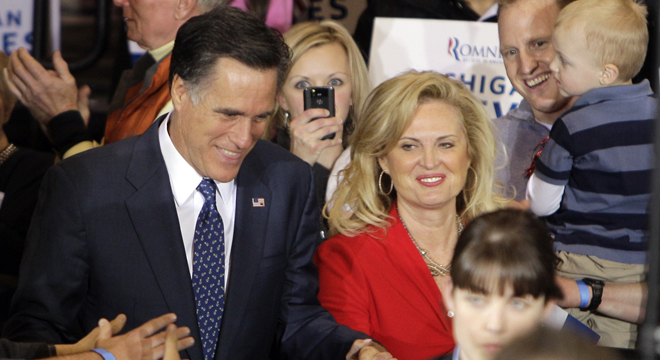
GRAND RAPIDS, MI – Mitt Romney survived a surprise scare from Rick Santorum in his birthplace of Michigan on Tuesday, with networks interrupting his top rival’s election night speech in order to call the race.
“We didn’t win by a lot, but we won by enough and that’s all that counts,” an upbeat Romney told a crowd of supporters.
After days of gaffes and gripes, Tuesday night’s dual-primary opened earlier with more good news for Romney. The former Massachusetts governor was projected as the victor in Arizona’s winner-takes-all primary by the major networks as soon as the polls closed.
His win in Arizona was not without its potential costs in the general election. Romney further tacked right on immigration, calling Arizona’s tough law a “model” for the nation in an Arizona debate and accepting an endorsement from the governor who signed it, Jan Brewer. Democrats are hoping that Romney’s continued embrace of a crackdown on undocumented immigrants will help motivate Hispanic voters to turn out in droves for President Obama, potentially putting Arizona in play as a swing state.
But the main focus of the fight was in Michigan, where both candidates were set to deliver their speeches. The reason: in many pundits’ eyes this isn’t even a battle Romney should have had to be in in the first place. This is Romney’s home state; he was born here, his father was governor here, and Romney beat John McCain handily here only four years ago. His campaign and Super PACs supporting it also outspent Santorum and his allies 2:1 in advertising.
Even his close allies admitted a loss to Santorum could upend his campaign. Romney made something of a preemptive strike on this in an interview with Fox News. He told his hosts that it would be more significant if he “was turned down by Massachusetts” — the state he had lived in for forty years. He also slammed any talk of a brokered convention or of himself slipping out of the fight, framing the race as a drawn-out battle of attrition that was all about the delegates.
A win, however slim, should help stave off a panic. But even then, it’s possible the media will join in the framing the contest as a loss. Santorum and conservative pundits like Rush Limbaugh have made the case that the mere fact he’s forced to fight a tough battle in his birth state is an intrinsic sign of his weakness as a candidate.
Santorum framed himself as the underdog in Romney’s “backyard” in his concession speech, playing up this notion.
“A month ago they didn’t know who we are, but they do now!” he said.
While he called Romney to congratulate him on his victory before addressing his own supporters, Santorum did not mention his win in the speech.
Neither candidate looked their best in the final days of the race. Mitt Romney made a series of gaffes related to his wealth, talking up his wife’s multiple Cadillacs and attending the Daytona 500 only to admit that, while not a big fan of the sport, he’s friends with some NASCAR team owners. He also struggled to articulate a clear explanation of his opposition to the 2008 and 2009 auto bailout, an issue that President Obama is already using in speeches to hammer his Republican rivals.
Santorum, for his part, did himself few favors by picking a series of distracting fights over contraception, prenatal testing, whether college education was a liberal brainwashing operation, and even Whitney Houston’s death. While his campaign complained that critics were ignoring his more economy-focused stump speeches, these social issues dominated coverage and prompted anti-Santorum conservatives to accuse him of painting their party as extreme.
Muddying the waters somewhat, Democratic activists led by the Daily Kos urged progressives to vote for Santorum in Michigan in order to weaken Romney’s frontrunner status. Santorum courted crossover votes as well, recording a series of robocalls selling himself to Democrats as a protest vote against Romney. While Romney condemned Santorum’s outreach as a “dirty trick,” Santorum said he was merely reaching out to “Reagan Democrats” who might be amenable to his candidacy.
The early exit polls contained mixed news as to whether these efforts actually had much of an impact: Democratic turnout was estimated at 9%, mostly in line with recent GOP primaries in the state, but skewed strongly towards Santorum. At least some Democrats could be spotted at the polls on Tuesday with an explicit intent to make mischief.
Benjy Sarlin contributed to this article from Washington, DC