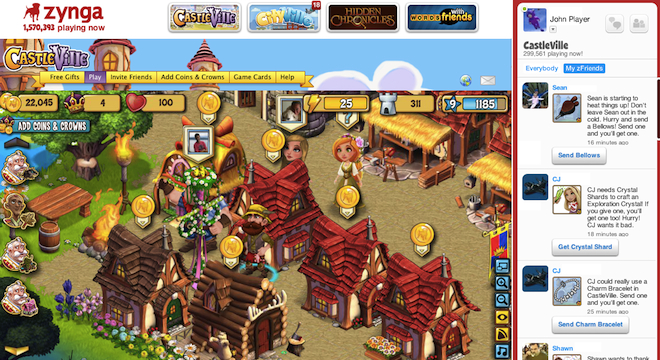
They’re not playing around anymore. Zynga, maker of popular Facebook game “Farmville” and mobile hit “Words With Friends,” on Thursday unveiled a new gaming social network it calls the “Zynga Platform.”
Zynga’s 232 million monthly active users can now play five of the company’s hit free games on the newly redesigned Zynga.com site and receive social notifications of their friends’ gaming activities, without the need of Facebook or mobile devices, although Zynga promises that it will still work with both.
Not only that, but Zynga plans to offer more of its own free games on the site later in the year and make its new website and gaming platform available to third party developers as well, in some ways directly competing with Facebook as a social gaming arena and publisher.
“We’re building a dedicated environment for our players to interact with each other around our games and we’re excited to make that network available to our fellow developers so our players can enjoy their awesome games too,” wrote Zynga founder and CEO Mark Pincus in a blog post announcing the radical shift.
Much of the tech blogosphere interpreted the move as a clear loss for Facebook. “Zynga’s Declaration of Independence” is how A.J. Glasser characterized the announcement at the unofficial blog Inside Facebook. As gaming writer David Thier wrote at Forbes: “The message is clear: Zynga is saying that it doesn’t need Facebook anymore.”
Thier went on to point out that Zynga, presently a $5.5 billion dollar company, went public before Facebook, trading on the NASDAQ as of December 16, 2011, despite being only four years old.
The timing of Zynga’s announcement also appears to be calculated to steal some of Facebook’s thunder in the wake of just filed IPO paperwork (Facebook wants to begin trading public stock later this year, giving the company a valuation of up to $100 billion dollars).
In Facebook’s February 2 S-1 filing, the company admitted that Zynga accounted for an unbelievable 12 percent of Facebook’s entire $3.7 billion revenue in 2011, through Zynga users’ spending on virtual goods and Facebook ads sold alongside Zynga games.
But Zynga took pains in its announcement to assure readers that it was not abandoning Facebook — far from it. In fact, players on Zynga’s new platform will, at least for the time being, still have to log-in with their Facebook accounts and spending can only occur using Facebook Credits, the website’s virtual currency, as the unofficial All Facebook blog noted.
Pincus seemed to want to praise Facebook in his blog post, but also appeared to drop a backhanded compliment, calling the world’s largest social network a “dial tone” — not exactly the most flattering description:
“In 2007 Facebook changed the game with their courageous move to open their platform to us all. We’re proud to be a part of Facebook’s ecosystem and we built Zynga.com to complement their pervasive social graph. Zynga.com will be one of the first sites completely integrated with Facebook which has become the world’s social dial-tone.”
Still, Zynga’s continued ties to Facebook are no doubt heavily influenced by the companies’ private contract, the details of which haven’t been disclosed.
“I can’t get into the particulars of our Facebook contract,” Zynga’s COO John Schappert told VentureBeat prior to the launch, “But I can say that I think it’s safe to say that they are our primary partner, and a great partner to us, and I hope that they would say the same.”
Facebook, for its part, brushed off the move as business as usual.
“We’re thrilled to see Zynga use our login and payments platform to expand the possibilities for people to play games in more places with their friends,” Sean Ryan, director of games partnerships at Facebook said in an emailed statement to TPM.
In fact, there may be reason to believe that Zynga’s shift is actually better for Facebook in the long run. As Richard Greenfield, an analyst specializing in digital entertainment at market observing company BTIG Research wrote in a blog post (sign-in needed) on Thursday:
Facebook skeptics will initially say this is Zynga’s way of separating itself from Facebook, creating a long-term way of removing its reliance on Facebook. We believe the Facebook/Zynga relationship remains strong and symbiotic – do not expect that to change because of today’s news. Facebook wants the world to be more social and Zynga.com’s main goal is to increase engagement/social activity around game play. In turn, more engaged social gamers should drive increased monetization – whether through sponsorship, advertising and/or virtual currency (credit) purchases, which directly benefit Facebook.
Plus, creating a whole new game-centric social network is easier said than done. As Ryan Lawler wrote at GigaOm: “I question how many casual gamers recognize that Zynga makes FarmVille, Words With Friends and Mafia Wars — and how many, knowing this, will take time out of their Facebook gaming sessions to go to some other site to play those games instead.”