NASA already has a bevy of official mobile apps, but the agency thinks that third-party developers around the world can do a better job of using its vast troves of spacefaring and Earth-watching data.
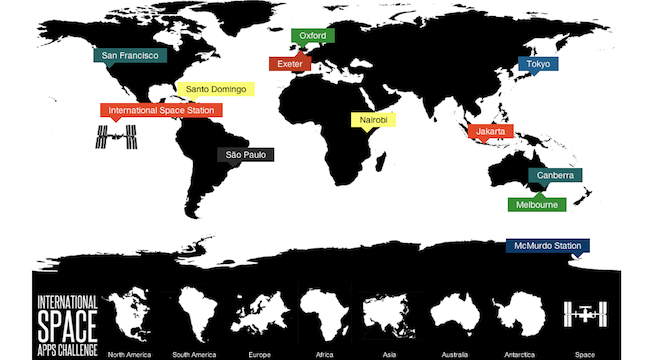
So on Friday, NASA announced the official countdown to an all-new event: The International Space Apps Challenge. It’s scheduled for April 21 and 22 in 11 locations on all seven continents around the globe (including Antarctica) and aboard the International Space Station (somehow).NASA calls it a “codeathon,” but the event is perhaps better known colloquially as a hackathon — a race between programmers to develop the best apps they can within a set time limit using NASA’s data. Local judges at each of the event’s hosting locations will choose the winners.
As for the specific components of the challenge itself: NASA has put a call out for programmers to take on seven distinct programming challenges across four categories: Software, Open Hardware, Citizen Science and Data Visualization. Each challenge is basically a loose request-for-proposal, offering various public NASA data sets as fodder and asking developers to do something interesting and novel with them.
For example, take a look at the open-ended description for the Kepler data visualization challenge, asking developers to do something with the data found in NASA’s quest for Earth-like planets and extraterrestrial life via the Kepler Space Telescope, an unmanned probe:
“The challenge is to help NASA either a) make Kepler data more accessible or b) create something amazing with it. It could be an app that better visualizes the data, an interface that presents the data in a new way, an infographic that helps understand the data in a new way, or more.”
NASA said it will post more projects weekly in advance of the event on its website. NASA has also begun accepting applications from individuals and participating organizations, but prospective entrants must undergo review and agree to abide by the privacy policy of “Random Hacks of Kindness,” a joint initiative from Google, Microsoft, Yahoo!, NASA, HP and the World Bank, which is helping to coordinate the event.
Moreover, all apps “must be submitted under a license that permits the free and open dissemination of the work.” That said, “NASA and the other supporting organizations do not own the rights to nor are committed to utilize any solution developed during the event,” according to the event’s FAQ.
NASA first conceived the idea for the event back in September 2011 as part of the White House’s Open Government Initiative, a commitment President Obama made on his first data in office to make the federal government more transparent.