Updated March 12, 1:20 p.m. ET
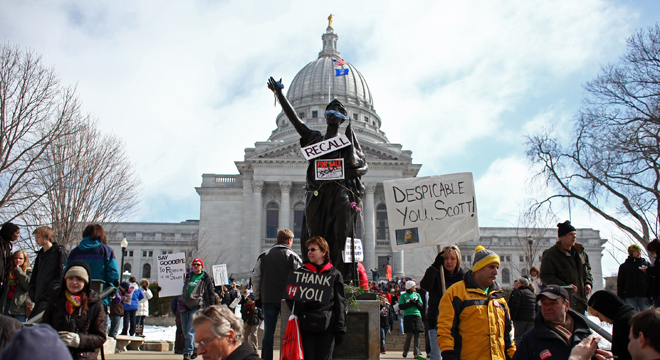
Wisconsin took major steps Monday towards triggering the state’s recall elections for later this spring.
The Government Accountability Board (GAB), which is made up of retired judges selected for the board in a mostly non-partisan manner, unanimously approved the recalls targeting four key Republican state senators — Majority Leader Scott Fitzgerald, plus Sens. Pam Galloway, Terry Moulton and Van Wanggaard.
Coming up later will be some key questions about the timing of the recalls, especially relating to the major contests of the statewide recalls targeting Gov. Scott Walker and Lt. Gov. Rebecca Kleefisch, with the elections likely to take place at some point in June.
But first, the board adopted some important legal recommendations, ruling against GOP attorney Joseph Olson, and virtually clinching that the Senate recalls would take place — and with some likely precedents toward the further arguments on the Walker/Kleefisch recalls.
The GAB formally rejected an argument that the Republicans have made, saying that any recall signatures should have to be collected only for the new post-redistricting lines — which would have thrown out a good number of signatures, and outright shut down the recall targeting Fitzgerald, as the Dems had conducted the petition drives under the old lines.
However, based on the construction of the redistricting law’s effective date for the new lines — set as the November 2012 general election — the GAB has applied the old boundaries to the recalls.
A legislative effort by Republicans to change the law stalled out, when a moderate Republican legislator who holds the balance of power in the state Senate gave it a thumbs-down. There are also ongoing efforts by the GOPers to litigate the issue — which appears to be on its way to becoming a moot point. But barring a law change, they have had to rely on determinations that legislators can officially communicate with people in the new districts for representative purposes.
GAB counsel Michael Haas pointed out that in the time since the redistricting law was adopted, there was a special election for the state Assembly. And in fact, that race was conducted on the old pre-existing lines, from the nomination papers for candidates to the conducting of the votes.
The GAB also turned down Republican arguments that the recall petition drives, which were first filed on November 15, did not become legally valid until they were clerically registered on November 17, thus disqualifying all signatures on the 15th and 16th — and also on the 17th, Olson argued, on the basis that one cannot determine which signatures were made before or after the time of clearance. The GAB staff reply was that effective registration for campaign committees has always been made retroactive to the filing, unless there were some deficiency in the filing that had to be dealt with.
The GAB will also not determine challenges based on generally-made allegations of similar handwriting in signatures, due to the imprecision of the issue and the lack of specifics in the challenges.
The Democrats’ lawyer Jeremy Levinson hearkened back to when he had himself tried to disqualify GOP-mounted recalls of Democratic state Senators last year: “On the handwriting analysis, I think the staff has got it right — and I say this as someone who tried this last summer and failed.”
Finally, the GAB rejected efforts to consider the work of an outside Tea Party activist group, Verify The Recall, on the level of official challenges that would require further investigation by the board. Haas cited “seriously flawed” data entry on the group’s part, involving human error in entering names, to which the GAB’s own internal operation was more thorough.
The state Democrats had officially targeted Galloway, Moulton and Wanggaard, who are in swing seats that the party lost in 2010. Then the local Recall-Walker organizers in Fitzgerald’s safe GOP district chose to take the extra initiative and target him with a recall. It is thought that he is highly like to win his race — but perhaps in the Dems’ favor, he might have to spend extra time in his own district, and less helping other candidates.
The four state Senate recalls also mean that for the second year in a row, control of the chamber will be up for grabs via recall elections.
Wisconsin Democrats last year, faced with a 19-14 Republican majority in the state Senate, attempted to mount a backlash against Gov. Scott Walker’s anti-public employee union legislation, by recalling their way to a majority. However, they were hampered by the fact that the only recall-eligible districts were in the half of the Senate ones where the incumbent had last won their terms in 2008, even during that year’s Democratic wave. The seats elected in 2010, when the Dems lost their majority, were not recall-eligible until one year into the term, wit the same going for Walker himself.
In the end, Democrats were able to pick up two seats, just short of the magic number of three, for a narrow 17-16 Republican majority. Out of the recall campaigns that were waged by both parties, four incumbent Republicans and three Democrats retained their seats, while two Republicans lost to Democratic challengers.
Late Update: State Senate Democratic Committee executive director Zac Kramer released this statement:
“The Wisconsin Government Accountability Board ruled overwhelmingly in favor of the 80,000 plus people that signed the recall petitions against four state senators in the recall elections. We are pleased of their decision. Again, our argument has always been that these recall elections should take place in the current legislative districts that took effect in 2002. We hope that this will stop the frivolous attempts by the GOP to halt the recall elections. We are encouraged that the elections will be swift, and held at the earliest date possible.”
When asked for comment, state GOP spokesman Ben Sparks reiterated a previous statement:
“A statewide recall election comes as a significant burden to the state and to local governments throughout Wisconsin, with one state-wide recall election costing more than $9 million, not including the cost of a primary. We urge the GAB to continue its efforts to ensure that these recall elections are held on the same date to reduce the growing burden and cost to Wisconsin taxpayers.”