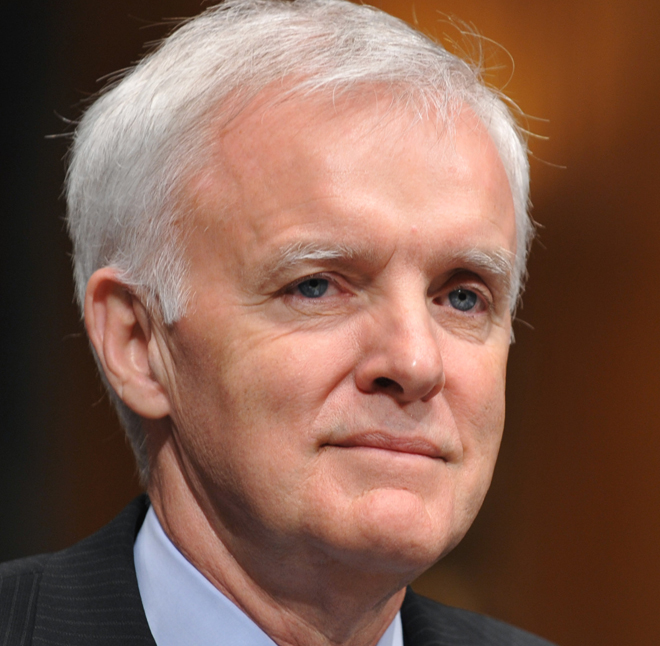
For someone who’s done this all before, it’s hard to believe Bob Kerrey’s campaign rollout for a Senate run in Nebraska could be so clumsy.
First he was out, leaving room for another Democratic candidate to step into the shoes vacated by Ben Nelson. Then he was in, forcing that other candidate to step aside. And now, in what should be the early days of reintroducing himself to voters of his state, he’s been dragged into a dispute over his voter registration and residency, as well as faced uncomfortable questions about whether a quid pro quo deal was struck to get him running again.
So, can he recover?
On paper, Kerrey is a candidate with a strong profile for a Democrat in deeply Republican Nebraska. He was elected to one term as governor in 1982, did not seek re-election in 1986 (though he very likely would have won), then easily won a Senate seat in 1988. And even in the Republican wave year of 1994, Kerrey was re-elected by a solid margin of 55%-45%, thanks to his personal popularity, his profile as a Vietnam Veteran and recipient of the Medal of Honor, and his record as a moderate Democrat.
Kerrey retired in 2000, and moved to New York City to become a university president for the next decade at the New School.
And in his return to Nebraska, in a much more polarized environment than existed in the past, Kerrey is off to a rough start.
It all started in late December, when Ben Nelson announced his retirement. This was not a simple case of an incumbent’s retirement putting his seat in danger for his party — because Nelson was already in a tough race for re-election.
Then in February, after much speculation about a possible candidacy, Kerrey announced that he was not running after all — which left Democrats with little time to find a new candidate, ahead of a tight filing deadline. It briefly seemed like Chuck Hassebrook, a member of the state University Board of Regents (which is an elected office in Nebraska), was the Democrats’ long-shot candidate for the seat.
But then later that month, Kerrey got in after all — which left Hassebrook in the lurch, as he was unable to file again for re-election to his Board of Regents seat. Despite initially saying that he would stay in the race, Hassebrook ultimately dropped out about a week later, and endorsed Kerrey.
Kerrey explained the turnaround in his decision to run, saying that his wife had originally opposed a run — and then she saw that it had left him unhappy to not run: “But she thought I had to reconsider, so I did. And we managed to come to a conclusion that we think we can manage this campaign and not interfere with our family.”
Kerrey later committed a faux pas when he told state reporter Joe Jordan that he had discussed the run with Senate Majority Leader Harry Reid, and obtained some promises. So what were they, Jordan naturally asked?
“I won’t tell you,” Kerrey said, laughing briefly. “It’s still a private conversation. I’ve talked to him this morning. But I’d like very much at some point soon to identify what they are. But they were important to me. And I asked for them, and he’s agreed. So I thought, I’ve got to respect that it’s a private conversation, and we’ll talk about it in a couple weeks, I guess.”
Kerrey has since clarified the situation, telling Omaha World-Herald that had received assurances his past 12 years of Senate service would be honored in some manner if he is elected, without any specific promise about seniority. But this hasn’t stopped the Republican group American Crossroads coming out with a radio ad that still warned about a (now non-existent) “secret deal with Democrat leaders in Washington.”
Right from when Kerrey got in, Republicans challenged the authenticity of his voter registration, and even his legal right to be a candidate. This is of course, a nearly impossible case under the U.S. Constitution — which only requires that a candidate be an inhabitant of the state, on the day they are elected. But this isn’t stopping them from trying to make political hay of it.
Nebraska Secretary of State John Gale, a Republican, issued an opinion containing critical language of Kerrey’s status, but nevertheless declared that he met the U.S. Constitution’s requirements to be a candidate. The state GOP has now responded by filing a court challenge, though it is likely to go nowhere fast.
So, with the Democratic nomination clear, Kerrey has focused on reintroducing himself to the state’s voters. He’s already up with two ads, one re-introducing himself to voters with a “Welcome back, Bob” theme, and one in which the candidate himself speaks about his concerns for the nation:
A recent Rasmussen poll showed Kerry trailing all three of the Republican candidates — state Attorney General Jon Bruning, former state Attorney General and 2000 Senate candidate Don Stenberg, and state Sen. Deb Fischer — by margins ranging from 12 to a whopping 22 points.
In an interview with TPM, one Democratic source challenged the sampling methods of the Rasmussen poll, and also sought to assuage further doubts about growing pains in Kerrey’s re-introduction to voters.
“I think obviously there’s something going on in the campaign in terms of getting everything off the ground and running,” the source said. “But I can tell you Bob has one of the best campaign managers in the country, and there isn’t a sense of worry, there’s a sense of confidence that the growing pains, so to speak, are short term.”