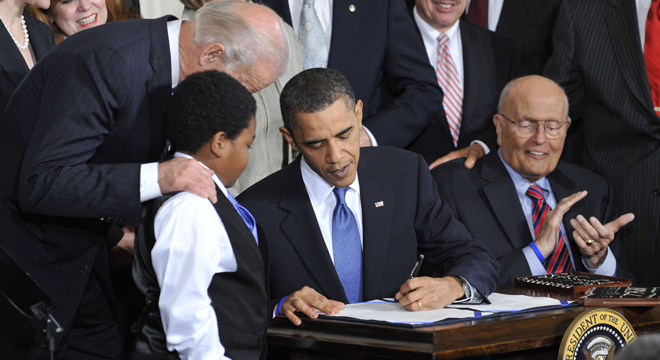
In the two years since its passage, heath care reform has been different things to different people. It was a landmark, generational accomplishment to Democrats. It was an enormous overreach of government to conservatives that sparked the Tea Party, pushing Republicans to the right. Americans in the middle, according to public polls, are against the law as a whole but are for its individual components.
Yes, the public’s opinion on health care reform is disparate, riddled with qualifications and subject to change when new information is introduced. And it turns out Americans don’t really hate it.
The top line result when asked what should become of the health care reform law is essentially broken into two camps. Question Americans on if the whole law should be repealed or not, they go for repeal. But a number of other surveys have come out over the last two months that employ a wider approach, asking three-pronged questions — repeal, a compromised position (repeal just the individual mandate, “modify,” give it some time to work) and keep the law. When given the option, many Americans are torn.
Two weeks ago a Bloomberg poll asked the multiple choice version: 37 percent of Americans said repeal health care reform, 46 percent we should see how it works, and 11 percent said to leave it alone. A Pew survey went even further, with 38 percent of Americans saying repeal the law, 20 percent saying to leave it alone, and 33 percent saying the law should actually be expanded. Kaiser tracking polls on the issue have shown the same thing for more than a year, dividing responses into four categories, with the largest plurality being “expand the law,” which has hovered in the high twenty and low thirty percent range.
So there’s a middle ground. But what’s become clear since the bill was signed is that if the political characterizations of the health care law are between broad strokes and specific provisions, opposing forces may fight to a draw on the bill. That’s the reason pollsters say the most effective way for the Obama team to re-sell the law is to highlight the specific attributes and ask what the law would be replaced with.
The challenge to that approach is Kaiser’s polling shows that specific knowledge of the law has gone down from the time it was passed, the sentiment to completely repeal (when given only the option to scrap or keep) the law has maintained its strength and even improved. In fact, the component that has remained most known — the individual mandate for citizens to purchase health insurance — is the most unpopular by far, as 54 percent of Americans in Kaiser’s latest tracking poll said they had an unfavorable view of the requirement.
Check out the chart below, which shows the percentage of Americans who correctly identified if these individual components were contained within the health care reform law over time.

Here are the numbers on the percentage of Americans who would support repealing the law totally versus who would keep it intact.
Finally, it seems that no matter what happens with the health care reform law directly, the ire of Americans is really directed toward politics in general, which comes as no surprise. The Bloomberg poll asked respondents if the Supreme Court decision will be made on the merits, or if it will be affected by politics. It wasn’t close.
Three quarters of Americans polled said politics will sway the decision, while 17 percent said it will be free of influence. And that might be the one combining factor, liberal or conservative, pro or anti-repeal: even enacted attempts at solving problems are continuously litigated, and citizens are cynical about it.