TINA CASEY
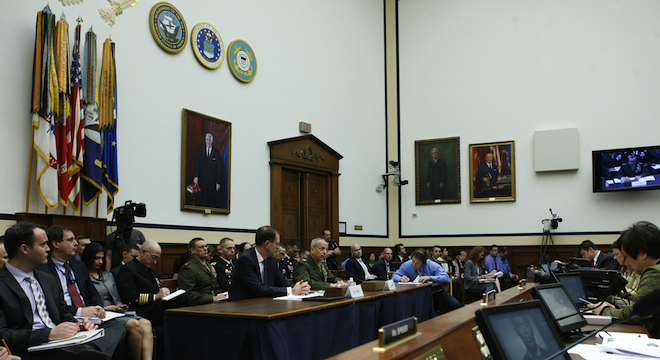
The Department of Defense’s adoption of solar power and other forms of alternative energy will come under scrutiny in Congress today, as the Subcommittee on Readiness of the House Armed Services Committee has scheduled a hearing at 11:30 am ET under the somewhat innocuous title, “What is the Price of Energy Security: From Battlefields to Bases.”
However, if you’re expecting another one of those knock ’em down, drag ’em out showdowns over Solyndra in particular and alternative energy in general you may want to catch some reruns of previous grillings on C-SPAN, because recent events have taken some of the steam out of the anti-alternative energy push back.
For one thing, taxpayer funding for Defense Department alternative energy projects isn’t really a ripe target because the Department is launching more projects funded at virtually no cost to taxpayers, through power purchase agreements in which private sector partners builds and own the means of generation.
Just last week the Army announced that it expects to contract for $7 billion in these industry-sponsored renewable energy projects through its Energy Initiatives Task Force over the next few years, in order to meet its goal of getting 25 percent of its energy from renewable sources by 2025.
In power purchase agreements, the Army will pay only for the energy it uses. The rate will actually be less, not more, than it would be charged for conventional grid-supplied energy, leaving little red meat for opponents to gnaw on.
In a related series of contracts at no cost to taxpayers, the Army also expects to bring its energy efficiency partnerships with the private sector to a total of $2.5 billion within the next two years.
Regardless of the funding source, alternative energy opponents are swimming upstream against the military.
The Department of Defense is already heavily invested in alternative energy across the spectrum and it will be difficult to unwind these projects. As of fiscal year 2011, for example, the Air Force alone had 194 separate alternative energy projects operating or under construction at dozens of sites.
The Air Force is not only the Defense Department’s top purchaser of alternative energy, it also ranks #2 among federal agencies and #15 among all 1300 or so members of the U.S. EPA’s Green Power Partnership, which includes entire cities and major corporations.
Imaging is also beginning to play out in favor of alternative energy, as the Navy will field an entire Green Strike Group early this summer composed entirely of ships and aircraft propelled either partly or fully by non-petroleum fuels.
The Green Strike Group will make its debut in Rim of the Pacific, which since the 1970’s has been the largest multinational maritime exercise in the world. The biannual exercise is closely watched by military aficionados of all political persuasions.
If that isn’t showcase enough, this year’s RIMPAC could gain an even bigger boost from the anticipated summer blockbuster Battleship: The Movie, which incorporates ample real-life footage from RIMPAC 2010. The film is set to open shortly before the exercise begins and if it is a hit, millions of movie goers will be cheering for what is in effect the Green Strike Group.
As for the “Support our Troops” factor, the financial and human cost of shipping petroleum fuels to remote bases is an open secret, and the Marines and Army are both beginning to position portable energy harvesting technology and mobile smart microgrids as the new standard for military energy supply in war zones.
In particular the U.S. Marine Corps is using alternative energy to project a compelling image of its troops as self-sufficient, high tech warriors who travel light and scavenge what they need on the go. As described by Col. Bob Charette, director of the Marines’ Expeditionary Energy Office:
“Our ethos demands that we increase the efficiency of our gear and the use of renewable energy, so we maintain that leadership as modern-day Spartans.”
Against this backdrop, the sting has already gone out from at least one of the weapons that Republican legislators have deployed against alternative energy, namely, the bankruptcy of solar panel manufacturer Solyndra, which has been the subject of intensive scrutiny since last fall. As reported by Darren Samuelsohn of POLITICO yesterday, all that noise has come to nothing and legislators are crying uncle:
“Is there a criminal activity? Perhaps not,” Oversight and Government Reform Committee Chairman Darrell Issa (R-CA) told POLITICO after leading a hearing in which he questioned Energy Secretary Steven Chu. “Is there a political influence and connections? Perhaps not. Did they bend the rules for an agenda, an agenda not covered within the statute? Absolutely.”
According to Samuelsohn the damage may already have been done in terms of scaring potential investors away from the clean energy sector, but with the Department of Defense on board as an eager customer, it seems more likely that the only damage done is to the Republican Party’s previously lockstep support for most military initiatives.