

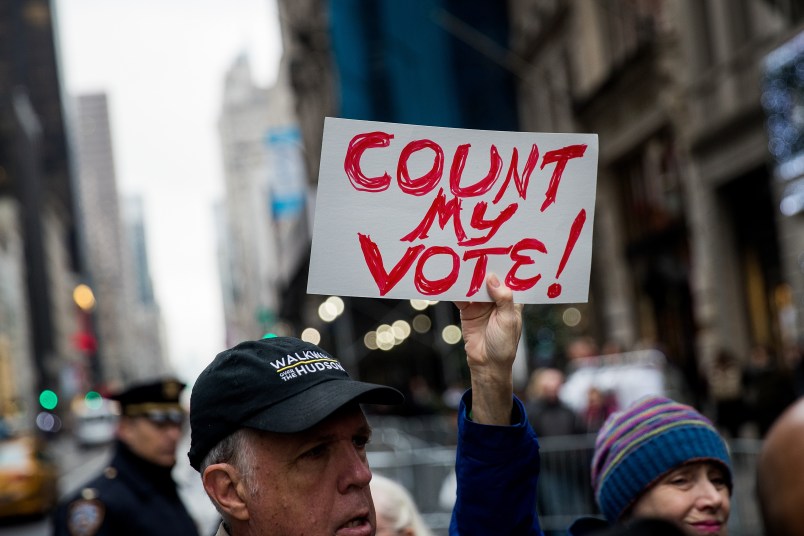
HARRISBURG, Pa. (AP) — The Pennsylvania Supreme Court struck down the state’s congressional map Monday, granting a major victory to Democrats who charged that the 18 districts were unconstitutionally gerrymandered to benefit Republicans.
In a 4-3 decision, the Democratic-controlled court said the boundaries “clearly, plainly and palpably” violate the state’s constitution, and blocked it from remaining in effect for the 2018 elections.
The justices gave the Republican-controlled Legislature until Feb. 9 to pass a replacement and Democratic Gov. Tom Wolf until Feb. 15 to submit it to the court. Otherwise, the justices said they will adopt a plan in an effort to keep the May 15 primary election on track.
The deadline to file paperwork to run in primaries for the state’s congressional seats is March 6.
“We won the whole thing,” said David Gersch of the Arnold & Porter Kaye Scholer law firm in Washington, D.C., which is helping represent the group of registered Democrats who filed the lawsuit last June.
The defendants — top Republican lawmakers — said they would ask the U.S. Supreme Court this week to step in and put the decision on hold. They said the state court’s decision lacks clarity, precedent and respect for the constitution, and that it would introduce chaos into the state’s congressional races.
The decision has immediate implications for the 2018 election, meaning that 14 sitting members of Congress and dozens more people are running or considering running in districts they may no longer live in. It also has implications for GOP-control of Congress, since only Texas, California and Florida send more Republicans to the U.S. House than Pennsylvania.
The decision came as the U.S. Supreme Court is weighing whether redistricting can be so partisan that it violates the U.S. Constitution, in cases from Maryland and Wisconsin. The high court has never struck down an electoral map as a partisan gerrymander.
Republicans who controlled the Legislature and governor’s office following the 2010 census broke decades of geographical precedent when redrawing the map, producing contorted shapes, including one dubbed “Goofy kicking Donald Duck.”
They shifted whole counties and cities into different districts in an effort to protect a Republican advantage in the congressional delegation. They succeeded, securing 13 of 18 seats in a state where registered Democratic voters outnumber Republicans 5 to 4.
The Pennsylvania court’s six-paragraph order did not lay out the rationale for striking down the 2011 congressional map, or which provisions of the constitution the justices believed it violated. That rationale could follow in the coming days.
The four justices throwing out the map were all Democrats, including three elected in 2015. The dissenting justices — two Republicans and one Democrat — gave varying arguments, including worrying about the logistics of making the decision effective in 2018 and not waiting for the U.S. Supreme Court to weigh in on pending federal cases, including one on appeal from Pennsylvania.
The March 13 special election in a vacant southwestern Pennsylvania seat is unaffected by the order, the justices said.




So when will SCOTUS overturn this one, too?
It doesn’t seem likely. This ruling was based on the state constitution, not the U.S. constitution. Unless the U.S. Supreme Court can find some basis for overruling a state court on this issue, this ruling will stand.
That’s what I vaguely remember from civics class a long time ago. As long as the State Constitution does not conflict with the US Constitution, the Supremes normally defer to the State.
This was the harshest, awesomest decision possible. It was also thought to be the least likely. This is a monumental win for Democrats!
I have to agree with kumquat16. The federal count would have to rule that the PA Constitution’s provision violates the US Constitution, which I don’t think they will do because that would open the floodgates to all manner of changes to state constitutions. Generally, unless a critical US Constitutional question is at stake – and it’s hard to see where there’s even a plausible argument for a federal issue which is necessary for the federal courts even to take jurisdiction – SCOTUS won’t even take the case.