

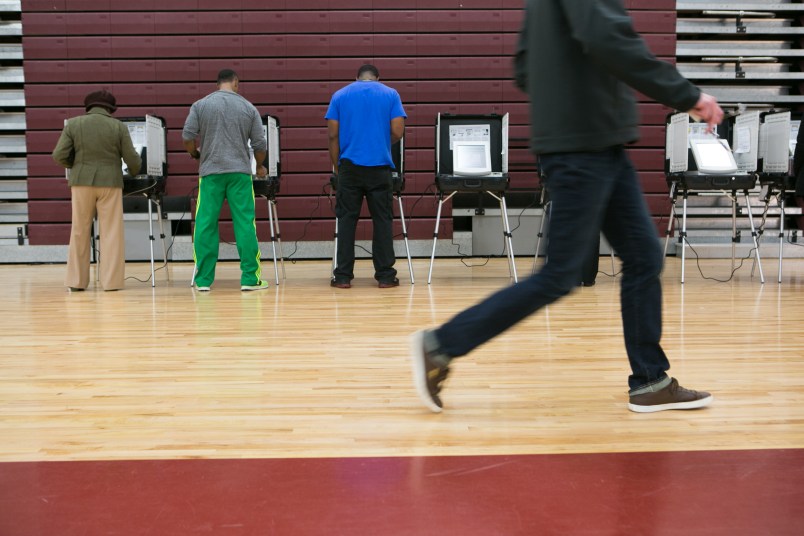
WASHINGTON (AP) — The fight for the House majority is over.
At least that’s the sense from a growing number of Democrats who are increasingly confident in their quest to seize control of at least one chamber of Congress six weeks before Election Day.
The surging optimism among Democrats, usually shared in private, has begun to spill into the open as President Donald Trump’s approval ratings sink and the Republican Party struggles under the weight of the president’s self-imposed political crises and erratic behavior.
“I do believe Democrats will win back the House of Representatives,” said New Mexico Rep. Ben Ray Lujan, chairman of the Democratic Congressional Campaign Committee. “Our candidates are in a strong position.”
Democratic confidence is particularly strong among campaign operatives who work closely with women, a critical voting bloc that has turned away from Trump’s GOP in the suburban and exurban districts where the House majority will be won or lost this fall. Polls suggest women are turbocharged and eager to punish Trump’s party as the voting season begins.
“I have all intentions of this institution delivering the U.S. House back for the Democrats,” said Stephanie Schriock, president of EMILY’S List, an organization that supports female Democrats. “We have the candidates in place to do that and then some.”
But with the shock of Trump’s 2016 victory still fresh, some Democrats are painfully aware that significant factors could emerge in the 45 days before the election that could derail their presumptive success. They’re contending with massive spending by GOP super PACs, competing in gerrymandered congressional districts and are increasingly worried about some key candidates.
That’s leaving some top Democrats warning their party of the dangers of overconfidence.
“This is no time for confidence. This is no time for braggadociousness or bluster,” New Jersey Sen. Cory Booker told The Associated Press in a recent interview.
Booker, a potential 2020 Democratic presidential contender, reminded his party of Hillary Clinton’s stunning loss in the last presidential contest: “If there’s any complacency, if there’s any resting on their laurels, we need to go back to how people felt in the early days of November 2016.”
That’s a tough message to push at a time when even Republican campaign professionals publicly and privately acknowledge that conventional metrics for predicting election outcomes favor Democrats.
At this point in President Barack Obama’s first term, Gallup reported the Democrat’s approval rating at least five points higher than Trump’s current 38 percent approval. Obama’s party would go on to lose 63 House seats in 2010.
On top of Trump’s low approval, Republicans this year have also been saddled by more than 40 House retirements, ceding the power of incumbency in several competitive races. And there are continued signs that the Democratic base is far more energized in the early years of the Trump era than the GOP.
“I would never tell a politician to be confident because of how the world changes,” said Republican strategist Rick Tyler. “But by applying those metrics, Democrats should pick up 80 seats.”
Former Democratic National Committee Chair Donna Brazile turned heads in a recent interview with ABC when she predicted a Democratic takeover in the Senate. Democrats need to pick up just two seats to claim the Senate majority, but most of the competitive Senate contests this year takes place in a Republican-leaning state.
“We’re confident,” Brazile said. “Not overconfident, but confident that we can run the tables in the Senate.”
Money could complicate Democrats’ plans.
While Democratic House candidates are outraising their GOP competitors in many cases, Republicans are expected to win the larger spending battle largely because of their reliance on Super PACs that can raise unlimited sums of money.
Schriock said EMILY’S List expects to spend $37 million to influence the election, outpacing its investment in the last presidential contest. On the other side, the Congressional Leadership Fund, a super PAC allied with House Speaker Paul Ryan, expects to spend roughly $100 million.
Already, the Republican powerhouse has committed more than $70 million to shape the House landscape, primarily by running attack ads to put Democratic candidates on defense as the midterm season moves into its final weeks.
In Minnesota, which began early voting on Friday , Ryan’s super PAC is dumping $8 million into an advertising campaign targeting two congressional districts. They include the 8th district, where 32-year-old former Democratic state Rep. Joe Radinovich faced charges that “he’s spent his life running from the law” in a recent ad that cites multiple traffic violations.
Radinovich’s campaign called the claims “egregious” and “disgraceful,” saying it falsely portrayed unpaid parking tickets as crimes and misrepresents a marijuana-related citation that the Democrat received as a teen.
Fair or not, the Republican attacks are jeopardizing an open seat in a Democratic-leaning state.
It’s not the only one.
Democrats are struggling for traction in a series of contests that should be prime pickup opportunities — on paper, at least. Polling suggests several vulnerable Republicans in swing districts are performing better than expected, a list that includes Reps. Carlos Curbelo of Florida, Will Hurd of Texas, and John Katko of New York.
And in Florida’s 27th district, a heavily Hispanic open seat in Miami, former Health and Human Services Secretary Donna Shalala is locked in a surprisingly close contest with Republican Maria Elvira Salazar, a well-known Hispanic television reporter.
But don’t relay those concerns to the people who lined up for hours outside Philadelphia’s Dell Music Center on Friday to see Obama rally Democratic voters in a pivotal swing state.
Della Jamison, a 65-year-old Democrat from North Philadelphia, was exuberant about her party’s chances when asked. In Pennsylvania alone, Democrats envision flipping a half dozen House seats.
“We are on the battlefield, baby,” Jamison said. “It’s already done.”
___
Peoples reported from New York. AP Congressional Correspondent Lisa Mascaro contributed to this report.



There’s no overconfidence on the side of Dems.
Every campaign I check in on is working hard from the ground up.
Winning ain’t easy. We all know this.
One of the things that is prompting these ‘slow your roll’ pieces are these junky NYT/Siena polls. We’re doing very well in a lot of them but there are a few where we don’t have a nominal lead. These polls have been flatly contradicted in other surveys (e.g., Monmouth). These guys don’t even pretend to hide it. They’re making it up as they go along. The bias in these polls that I detect is that there is a response rate bias towards traditional voters in the district. So, if you’re in a Dem district, you’re going to get more traditional regular Dem voter responses. If you’re in a traditional GOP district, you’re going to get more traditional GOP voter responses. The point is that these contested GOP districts are changing with newer voters, independent voters and more active Dem voters who collectively outnumber the GOP voters. These polls don’t pick that up. But one thing that they have picked up is that there are very, very few GOP incumbents that are hitting 50% or close to it. By that measure alone, the Dems are headed for a big victory. If you look at overall House polling in Florida, for example, the Dems are on track to win 4 to 8 seats there alone. That’s unprecedented for Dems. We have way more money than these GOPers and we’re putting it to work while we raise more. We have better candidates and better messaging. We’re going to win not because we’re overconfident, but because we are working hard and it’s not the other side’s year. Our candidates have to get to a threshold name ID for voters and they’ll more often than not beat the GOP challenger.
Yes, and I think a lot of people are mistaking overconfidence for hope. We have great hope that we can still save our democracy. Michael Moore was on Morning Joe the other day saying we shouldn’t even have hope. I like him, but he’s wrong about that. Hope is why I send Beto, Nelson, Gillum, and Abrams some money. Hope is what pushes someone in a ruby red district to go vote even if they just know there’s no way a Democrat can pull it off. Hope is all we’ve got.
It only works if if hope and confidence translate into votes. But I think it is different this time…and I don’t think that is either hope or overconfidence.
From your lips…I saw plucky’s response before I saw your full post. It is different this time. You can sense it, feel it. But I am still ever so vigilant. And it remains totally shocking to me that we have to fear Russian operatives as much as we do the ones from the GOP. And that they all work for the same cause.
I was in an election officer training session in my county this morning. In the past I’ve worked at polling precincts. This time I’ll be processing absentee ballots. One of the trainers said that they mailed 25,000 absentee ballots yesterday. A year ago they mailed about 10,000. She said there’s more interest in this year’s mid-term election than she’s ever seen in any other non-presidential election. Everyone in the room nodded our heads knowingly. We couldn’t say anything about the motives for that interest, because we can’t discuss our political views at all, either among ourselves or with anyone in the voting public when we’re on duty, but we all knew what she was talking about.
I think turnout will be huge this year. Probably not as much as in a presidential year, just because, but a lot of people want to have their say. And - I hope - a lot of people learned that leaving it up to others to carry the weight of voting (because I’m too busy, or I don’t really like either candidate, or it’s raining…) doesn’t always lead to good results. If we get high turnout, and lots of absentee ballots returned, Dems should win big. Turnout is the key.