


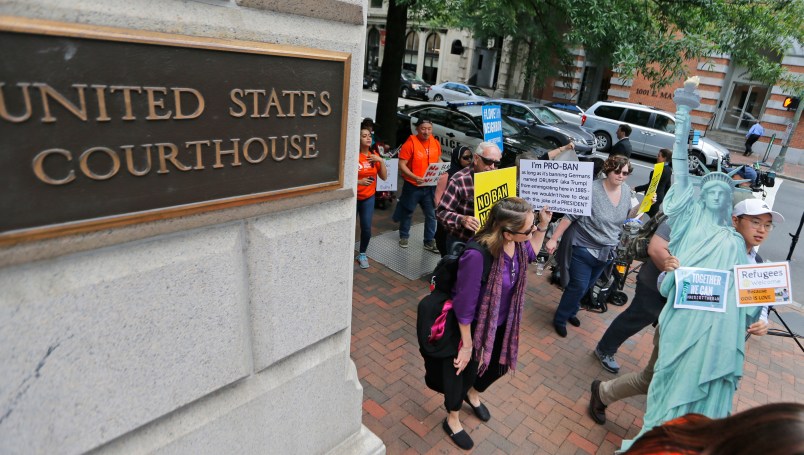
The full 4th U.S. Circuit Court of Appeals in Richmond, Virginia, heard oral arguments Monday afternoon in the ongoing legal saga of President Donald Trump’s ban on travelers, immigrants, and refugees from six majority-Muslim nations: Iran, Libya, Somalia, Sudan, Syria and Yemen.
“This is not a Muslim ban,” said Acting Solicitor General Jeffery Wall, arguing on behalf of the government that those “dangerous” countries don’t have the proper infrastructure for vetting travelers to the U.S. and weeding out national security threats. “It’s based on government conduct, not religious expression.”
The 4th Circuit judges were vocally skeptical of this argument, pointing out that Trump and his advisers have repeatedly and explicitly said that their goal was to ban Muslims from entering the U.S.
“What besides willful blindness would prevent us from considering those statements?” asked Judge Henry Floyd.
Judge James Wynn agreed, saying: “The statements are relevant there. There is an affirmative duty for the court to look if there’s bad faith” behind any law it evaluates.
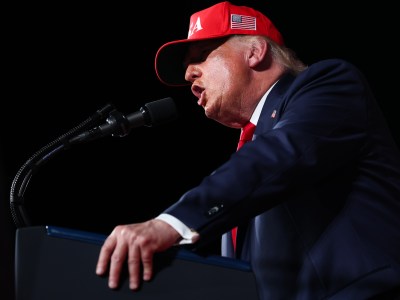
But Wall told the court they should ignore all of Trump’s statements promising a “total and complete shutdown of Muslims entering the United States” and only evaluate the text of the executive order itself. He warned the judges against “reaching back to campaign statements,” and said that Trump statements on the campaign trail shouldn’t count, because he hadn’t yet taken an oath to uphold the Constitution yet.
Wall said that leaving Trump and his associates’ remarks aside, the judges should find that the travel ban is “neutral on its face and neutral in operations.”
Judge Pamela Harris was not having it.
“What are you talking about?” she cut in. “How is this neutral in its operation? This obviously has a disparate impact on Muslims. I literally do not know what you mean.”
A few judges, however, were tougher on the lawyer representing the American Civil Liberties Union, which is challenging the travel ban as unconstitutionally discriminatory.
Judge Dennis Shedd, one of the court’s most conservative members, asked why the Trump administration shouldn’t be afforded the court’s deference in determining which countries present a national security risk. “He thought this was in the interest of the country,” he said.
Judge Paul Niemeyer agreed, raising his voice: “Don’t we have some respect for the first branch?” Niemeyer also questioned whether the plaintiffs separated from their families had really suffered a legal injury, considering that the ban is purportedly temporary.
Yet overall, the court, appeared more favorable to the arguments by the ACLU and the International Refugee Assistance Project that the ban does not serve a legitimate national security purpose.
Judge Wynn even compared the travel ban to the internment of Japanese Americans during World War II, another policy justified at the time by arguing a national security threat existed. “If we don’t lock them all up, and something bad happens, it is the president’s fault?” he asked.
The executive order before the court is the Trump administration’s second attempt to implement a travel ban. The first, which covered seven countries of origin and included green card holders, was struck down by a federal district judge in Washington State, who like the Fourth Circuit cited statements by Trump and his allies on the campaign trail as evidence the policy was motivated by discrimination against Muslims. A panel of judges on the 9th U.S. Circuit Court of Appeals upheld that ruling.
The administration signed a second, slightly narrower version of the ban in March. But that too was blocked by federal district judges in Hawaii and Maryland who pointed to “significant and unrebutted evidence of religious animus” behind the policy.
In particular, they cited a statement by White House policy adviser Stephen Miller admitting that the second travel ban was designed to have “the same basic policy outcome” as the first.
Next week, a three-judge panel of the 9th U.S. Circuit Court of Appeals will also hear the case.






“But Wall told the court they should ignore all of Trump’s statements promising a “total and complete shutdown of Muslims entering the United States” and only evaluate the text of the executive order itself.”
Yes–By all means we should completely ignore Trump’s publicly, loudly, and repeatedly demagoguing the issue for the past two years in favor of the text of a single document.
How did this end up being heard en banc? Did someone petition to bypass a panel opinion or did I miss a panel opinion somewhere? Given that Obama turned it from one of the most conservative to one of the most liberal circuits (and the Fourth is “my” circuit, so it was damn welcome), going straight to en banc consideration does not help Trump.
Trump’s words and all his enablers’ words are killing them.
The words all signify INTENT, which is why they will keep losing.
“Well, that went well,” said Acting Solicitor General Jeffery Wall, to no one in particular.