

This story was originally reported by Shefali Luthra and Grace Panetta of The 19th. Meet Shefali and Grace and read more of their reporting on gender, politics and policy.
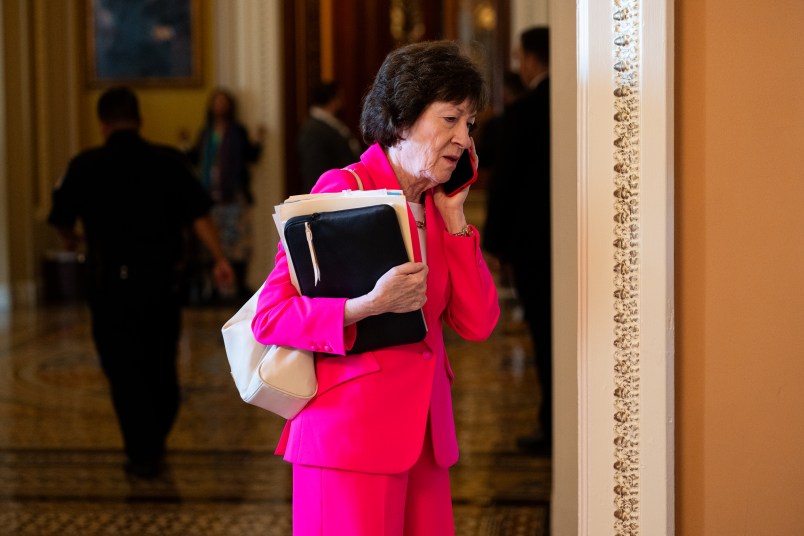
BANGOR, Maine — As Maine Democrats vie to replace Graham Platner in their state’s Senate race, abortion — a key weakness for Republican Sen. Susan Collins — is set to shape the next phase of the contest, which Democrats view as a prime pick-up opportunity.
Collins, whose home state voted for Kamala Harris in the 2024 election, is considered one of the most vulnerable Republican incumbents up for election this year. She has held onto power despite Maine’s blue tilt in large part by branding herself as an independent, and by highlighting her support for healthcare and abortion rights.
But Democrats have sought to challenge that narrative, pointing to Collins’ 2018 vote to confirm Supreme Court Justice Brett Kavanaugh, who four years later joined a 5-4 majority to overturn Roe v. Wade, the landmark abortion rights case. Collins criticized the decision at the time, calling it “ill-considered,” but Democrats are making her vote a central issue.
“It’s rare in modern politics to be able to draw such a straight line between one vote and devastating health consequences,” Nirav Shah said while speaking to voters at a town hall event at a movie theater in Bangor on Sunday. “But in the case of Senator Collins, we have a case study in why every vote as a U.S. senator matters.”
Shah, a former head of the state’s Center for Disease Control and Prevention, is one of several Democrats running to replace Platner’s spot on the ticket.
“One of her biggest vulnerabilities is abortion, and she knows it,” said Mini Timmaraju, president of abortion rights group Reproductive Freedom for All.
“She’s been a massive disappointment, and Maine voters do not approve of her lack of leadership on this issue,” Timmaraju said. “So, absolutely, I think no matter who the nominee is, abortion and reproductive rights, access to contraception, IVF, the whole list, are going to be really salient in this race.”
Platner, the Democrats’ previous nominee, withdrew from the campaign last week after Politico published a report detailing a former girlfriend’s allegation that he sexually assaulted her five years ago. The Maine Democratic Party now has until July 27 to name a new nominee. The candidates vying for the seat include Shah, former state Senate President Troy Jackson and Maine’s Secretary of State Shenna Bellows, all of whom ran in the recent Democratic primary for governor. Jordan Wood, who ran for the 2nd Congressional District, and Dan Kleban, a businessman and owner of Maine Brewing Company, have also thrown their hats in the ring.
“Even though Platner fever is at such a swirl right now, I do think it dies down and the race becomes about Collins,” said Molly Murphy, a pollster at Impact Research, a Democrat-aligned firm. “And my gut is that the main frame on her is that she’s supported [Donald] Trump on terrible things, but abortion is a big part of it.”
This is Collins’ first reelection contest since Roe’s overturn allowed states across the country to ban abortion. The procedure remains legal and protected in Maine. Two-thirds of voters in Maine believe abortion should be legal in most or all cases, according to polling from PRRI, though less than half a percent of voters said it was their top voting issue in a recent New York Times/Siena College poll.
Collins and GOP Sen. Lisa Murkowski of Alaska had previously introduced a bill to codify Roe and a subsequent decision, Planned Parenthood v. Casey, into federal law. In the wake of the high court’s decision in Dobbs v. Jackson Women’s Health Organization, Collins also signed onto bipartisan legislation that would codify those decisions and other rulings protecting the right to contraception; neither bill received a vote on the Senate floor. The anti-abortion group SBA Pro-Life has given her a grade of D for her votes in her current term and an F for her past term, while Reproductive Freedom for All has given her high scores for her voting record in past years, including 2023 and 2024, but the group gave her a score of 18 percent for 2025.
As recently as May 2025, when Congress was considering its sweeping tax-cut and spending bill, Planned Parenthood Maine Action Fund put out a media memo emphasizing Collins’ “long history of supporting Planned Parenthood and access to essential healthcare.”
“Throughout her career, Sen. Collins has made it clear she understands how critical Medicaid is to her constituents and all Americans’ ability to access essential healthcare,” read the document, which appears to have since been removed from Planned Parenthood’s website. “She knows cuts to the program will harm Mainers. Sen. Collins has also affirmed the important need Planned Parenthood health centers fill in providing care to Mainers, regardless of ability to pay.”
But Timmaraju argued that Collins, who leads the powerful Senate Appropriations Committee, has been “wishy washy” in her support for Medicaid coverage and funding for clinics that offer reproductive health services in Maine.
And when asked by a reporter last month if she regretted her vote for Kavanaugh, Collins said: “I do not regret that vote,” while emphasizing her disagreement with the Dobbs decision and noting that three other justices she voted to confirm — Justices Sonia Sotomayor, Elena Kagan and Ketanji Brown Jackson — dissented in the case.
“When I look at a justice, I look at their qualifications, their integrity, their background, their experience in reaching a decision,” she said. “Obviously, I’m disappointed in that decision, which turned abortion issues back to the states. It has not had an impact on the state of Maine in that Maine actually expanded its law.”
Nevertheless, Collins’ saying she didn’t regret her vote became instant fodder for Democrats, who cut her answer into ads.
Before dropping out, Platner had begun to argue that he would champion reproductive rights in the Senate, touting an endorsement from Planned Parenthood and calling the health provider a model organization. He’d also aired television ads attacking Collins on her vote for Kavanaugh and highlighting her recent comments defending her vote to confirm him.
Now, the looming reset — and the chance to create some distance from Platner’s scandals — offers Democrats a fresh chance to highlight reproductive rights, said Celinda Lake, a veteran Democratic pollster.
“There are a lot of voters for whom this is a major question about her,” Lake said. “It’s a major question any candidate will raise.”
An opponent who can effectively speak about abortion could cut into a key source of support for Collins: women 65 and older, who largely support abortion rights — but who recent polling suggested had only narrowly backed the incumbent over Platner.
“If you take those older women away from Collins, she loses,” Lake said.
In a state that values lawmakers with an independent streak, Collins has consistently won reelection by emphasizing a record of bipartisan achievements, including bringing funds and resources back to Maine, and by openly breaking with Trump in some cases. But at Shah’s Bangor event, older women voters said they were dismayed by what they saw as Collins’ failure to stand up to Trump’s agenda.
“We have to do everything we can to replace Susan Collins,” said Michaela Loisel, a voter who drove up to the event in Bangor from Hollowell with her daughter, who recently started working on Shah’s campaign. Loisel hoped she would have a “Margaret Chase Smith moment,” referring to the former Republican senator from Maine who stood up to her party and opposed Joseph McCarthy’s anti-communist push, but said she’s “blindly supporting the Trump administration.”
Nancy Prisk, 76, who has lived in Orono for over 20 years, is one of many Maine Democrats who have voted for Collins in the past. But she said she believes Collins “has blinders on to what meets her needs,” a factor she argued motivated Platner’s campaign.
“Anything she voted for that is contrary to the beliefs of the people of Maine,” Prisk said, will be a vulnerability for her.
Outside Democratic groups are also highlighting abortion in what is set to be one of the most expensive and highly watched Senate races in the country. Affordable Maine, a group with ties to a major Democratic super PAC, launched a $2.5 million ad campaign on Friday hitting Collins on her vote for Kavanaugh and other Trump-nominated judges.
All of the potential Senate candidates favor abortion rights, though it became a source of contention in the governor’s race due to an outside group, which supported Shah, airing ads attacking Jackson for his past anti-abortion votes earlier in his career. Jackson, who had for the last decade been a strong supporter of abortion rights, called the ads misleading, noting his co-sponsorship of reproductive health bills and 100 percent rating from Planned Parenthood.
Shah distanced himself from the ads attacking Jackson and called for them to be taken off the air.
“I want to be super clear: this is not about what any one person’s views are right now,” he told The 19th in Bangor. “I believe people when they tell me what their views are, my concern is that in a general election context, when we have an imperative to beat Senator Collins, those prior votes will be seen as liabilities.”
In a new ad released in his Senate bid, Jackson doubled down on his support for abortion rights. “When I was Senate president, I was always on the right side of this, pushing for more access,” he said. “People should know that they can count on me and I have their back.”
Timmaraju said that in light of the issue’s salience and the fact that women voters make up the majority of the electorate in Maine, Platner’s replacement must have “a very clear record” on abortion.
“I think we have to make sure that person is unimpeachable and especially in a state like Maine, they cannot take women voters seriously enough,” she said. “And right now, sort of a basic contract with women voters in the state has been violated.”
Though Maine has moved to expand state-level abortion protections in the past four years, medical providers in the state say they’ve faced an onslaught of federal attacks, the result of an emboldened national anti-abortion movement.
They pointed to the tax-and-spending bill enacted last year, which slashed Medicaid and which also barred reproductive health providers — Planned Parenthood but also Maine Family Planning — from billing the insurance program for non-abortion health services, such as contraception and cancer screenings. Collins voted against that bill but did vote yes on a key procedural measure that allowed it to come to the Senate floor.
Dr. Jiana Menendez, the medical director for Maine Family Planning and a physician based in Augusta, highlighted particular concerns about abortion opponents’ efforts to restrict the availability of abortion medication, namely the drug mifepristone, which is used in most abortions, and which can safely be provided in-person at a health center or virtually through telehealth.
The latter is a popular choice for patients who live farther from a clinic. At Maine Family Planning, which largely serves rural patients, about a third of all medication abortions it provides are done through telehealth.
Anti-abortion activists have pushed for the federal government to reverse the Food and Drug Administration decision that allowed for mifepristone to be provided via telehealth, a move that would require all patients seeking abortion to travel in-person to a clinic. Menendez described a recent case where she cared for a college student who had driven two hours to come to her clinic because she could not find a closer option.
“People are still focused on this really important issue and it should be part of the conversation. Reproductive rights — the ability to decide if, when, how to become a parent, how to build your family — that’s fundamental,” Menendez said. “It’s important to protect that and I’m glad people see how critical of a moment we’re at.”






She should be hammered on health care as well. Both Collins and Snowe promised to support the ACA is certain provisions were written in. The provisions were written. Both failed to support it. She has done nothing about health care since.
Good. Also, “When I look at a justice, I look at their qualifications, their integrity, their background, their experience…” It’s amazing she didn’t burst into flames from her pants being on fire when she said that.
“Resettling around abortion.” Apparently the professional Democrats have no idea why the people of Maine nominated Planter or don’t care. They are a one trick pony without a saddle.
You’re reading my mind. Was going to post earlier but was distracted by cat walking across my KB.
Yeah, let’s go with abortion, new and exciting wedge issue with voters undecided. This is so Dem Party taking over “winning” issues. I remember living in VT when VT was a poor state (in the 70’s when if it didn’t snow, you didn’t work). Maine was even poorer and still is. Affordability comes first, Trump toady Collins a close 2nd. Want more of Trump, vote Collins! Dems better come up with an exciting candidate or all is lost, once again.
I, too, am leery (very) of focusing on abortion to the near exclusion of everything else, as this post seems to suggest Maine Dems should do. Abortion is an important issue, no doubt, but should be situated in a larger context and integrated with other issues, most obviously Collins’ votes on Obamacare and Medicaid (via the Big Ugly bill) – which is to say, healthcare. Place that in the largest context of her repeatedly voting for Trump’s agenda, NOT LEAST, funding ICE. Today’s events have transformed the scene. Where does Collins stand on immigration and ICE’s criminality? Expose her posturing as an “independent.” Make her take responsibility for her support of Trump’s administration, which her mere caucusing with Repubs in the Senate commits her to.
Susan Collins reminds me of the local prosecutor jingling the change in his pocket in the brilliant film, “In the Bedroom.” Set in Maine.
My mind is meandering. But to my point: it won’t be all about abortion rights.