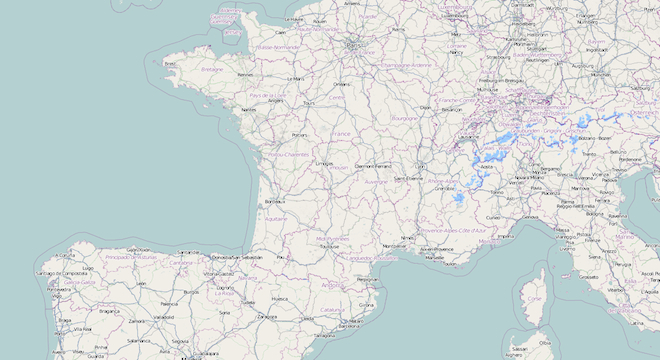
The organizers behind OpenStreetMap, a free crowdsourced digital world map, are still reveling in the news that Apple appears to have switched to using OpenStreetMap’s data for locations outside the U.S. in lieu of its previous default, Google Maps, in a new version of Apple’s mobile software.
OpenStreetMap has consistently celebrated Apple’s March 7 move, despite the fact that Apple still hasn’t credited OpenStreetMap for using its data, in violation of its generous usage policy.
But recent defections away from Google Maps by Apple and the mobile app Foursquare are just the beginning of what OpenStreetMap’s architects envision for the now eight-year-old project.
“We believe that OSM’s data will become the most widely used map data, just as Wikipedia has overcome doubters to become the most popular encyclopedia,” wrote OpenStreetMap Foundation board member Richard Fairhurst, in an email to TPM.
“Foursquare, Apple, Geocaching.com are but the most high-profile of a long list of switchers and we have every confidence that this will continue into the future,” Fairhurst continued.Fairhurst is a UK-based programmer, cartographer and travel journalist who’s been with the project since its inaugural year, 2004. He designed the OpenStreetMap’s map editing software, which allows the project’s registered members to update maps based on their own personal observations, in accordance with OpenStreetMap’s guidelines.
Currently, OpenStreetMap counts a mind-boggling 559,944 individual registered users, a number which has increased by 10,000 alone in the past week due in no small part to the high-profile defections of tech companies away from Google Maps.
Fairhurst said he in fact attributed “the great majority” of the 10,000 new users on OpenStreetMap to the media attention surrounding Apple’s and Foursquare’s switches.
“New OSM users often become involved because they realize they can improve the maps they use — in other words, if you’re a Foursquare user, you can improve your Foursquare experience by contributing to OSM,” Fairhurst told TPM. “Many apps and websites have used OSM data for years, but these most recent high-profile switches have brought us to the attention of thousands more potential users.”
That’s partially why the members of OpenStreetMap’s board of directors has taken Apple’s lack of proper citation so positively: It’s generating unprecedented buzz for their goals of becoming the Web’s best map.
“Increasing the number of contributors will result in even better coverage and a more detailed map, so anything that draws in more contributors has to be positive for the project,” Fairhurst noted. “Our success is entirely down to the collective work of our contributors.”
As Fairhurst pointed out, the OpenStreetMap project is structurally similar in many ways to Wikipedia, which allows registered editors to change and update encyclopedia entries. Also like Wikipedia, OpenStreetMap is overseen by a non-profit organization, the OpenStreetMap Foundation, which collects donations to pay for the necessary servers and acts as the general coordinator for the effort.
However, Fairhurst believes there are important distinctions between the two projects, chief among them how users access OpenStreetMap’s data.
“Unlike Wikipedia, we don’t believe this will be channeled through one website, but through the many sites, apps and publications using our data,” Fairhurst explained.
As for that missing attribution, OpenStreetMap still hasn’t received any word from Apple on whether or not the world’s most valuable company will be revising its new iPhoto app — which appears to use OpenStreetMap tile data for areas outside of the U.S. — to adequately reflect OpenStreetMap’s contribution. But OpenStreetMap hasn’t actually contacted Apple directly about the issue yet, either.
“We haven’t yet heard from Apple as a direct response to the recent publicity,” Fairhurst told TPM. “We’re assessing how best to make a formal approach to them requesting the attribution; we would of course anticipate that they’ll respond promptly to that.”
That said, OpenStreetMap does have good relations with other large online map repositories.
“Most importantly, Yahoo originally, and now Bing, generously provide overhead imagery which our contributors can use to locate and trace features,” Fairhurst said. “Google have not done this but have supported OSM development through their Summer of Code and their Open Source office.”
Still, OpenStreetMap has clashed with Google before, notably in mid-January when OpenStreetMap users discovered evidence that two Google contractors in India had apparently been subtly vandalizing OSM’s data, switching the direction of one-way streets, for example. Google confirmed that two of its contractors made the changes, but said that they were acting on their own (not with direction from Google) and that the culprits had been fired from all Google projects going forward.
OpenStreetMap has also openly celebrated the news that Google this year began charging major business users of its own Google Maps API (application programming interface) for the service. Once a company or app has exceeded 25,000 page loads of a basic version of Google Maps, Google charges $10 to $40 for every additional 1,000 map loads. The full version of Google Maps, including the whiz-bang feature Street View, begins charging after just 2,500 page loads. Google also offers its own separate annual and fixed pricing options for larger firms such as Apple and Foursquare, prices not disclosed to the public, but as Geoff Duncan at Digital Trends wrote in an excellent analysis piece: “It’s safe to say it’s not cheap.”
In addition, as Duncan notes, Google also serves up ads within its maps, even for paying customers. These two factors have led Duncan and others to theorize that Google is essentially driving firms like Foursquare and Apple into the arms of OpenStreetMap, which, although it lacks some of Google’s polish, never charges users and never serves up advertising, only asking to be credited in return. That’s not to say OpenStreetMap isn’t gunning for Google on features as well.
“Whereas most commercial datasets are suitable for car navigation and nothing else, our data, at its best, is so rich and detailed that it enables a myriad of uses,” Fairhurst told TPM. “We aim to encourage the growth of this data by attracting more contributors and making it easier for them to contribute.”