

 Members-Only Article
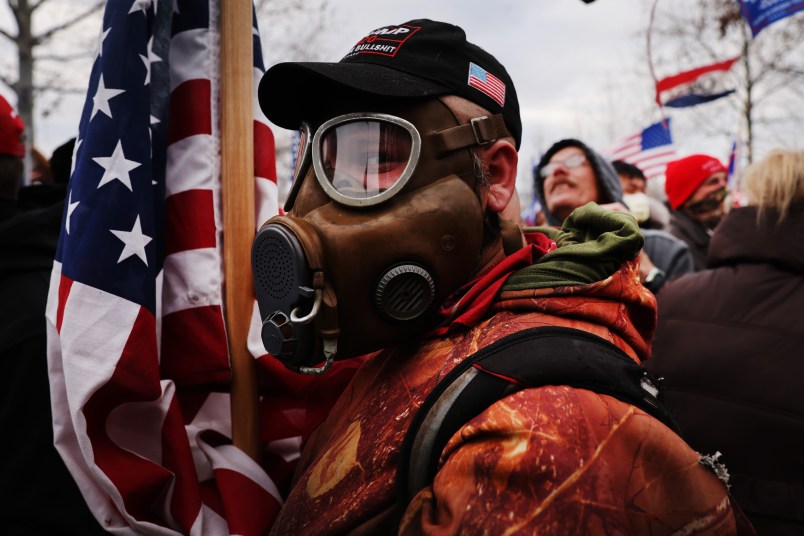
I strongly recommend you read Josh Kovesnky’s account of why the US government’s vaunted intelligence capabilities were caught utterly flatfooted by the events of January 6th despite that fact that one needed no greater intelligence asset than a Twitter account or at most one on Parler to know what could be coming.
A key cause of the failure is that no one wanted to raise an alarm about a security threat from the President’s own supporters. Indeed, no one really wanted to be caught investigating it.
This is both a shocking abdication of responsibility and entirely unsurprising given what’s happened to basically anyone in the federal security bureaucracy who’s gotten crosswise with the President. But we can’t understand this development without understanding or simply remembering that this is our fourth or fifth round of this cycle: the institutional Republican party rushing forward to claim that any effort to combat far right terrorism or organized political violence amounts to a crackdown on conservatives or bias against the GOP.
Many of you will recall that back in 2009 the Department of Homeland Security issued an intelligence report on the threat of right-wing extremist activity driven in part by the stresses of the global financial crisis and a generation of combat veterans returning from emotionally and physically scarring deployments in Iraq and Afghanistan vulnerable to radicalization by extremist groups. There was a big GOP freak out and eventually Secretary Janet Napolitano caved and rescinded the report. As the author of the assessment, Daryl Johnson, recalled in 2017: “Work related to violent right-wing extremism was halted. Law enforcement training also stopped. My unit was disbanded. And, one-by-one, my team of analysts left for other employment. By 2010, there were no intelligence analysts at DHS working domestic terrorism threats.”
But that wasn’t the first of these cycles.
Go back to April 1995 and the bombing of the Oklahoma City Federal Building. This sparked the first widespread interest in the militia movement which had begun to take root in the country in the 1980s. But Republicans, who had just taken control of Congress in January of that year, quickly shifted gears to defending militias as conservatives being smeared the association with McVeigh and his accomplices. Indeed, in June of 1995 the Senate held a hearing aimed at humanizing members of the militia movement as little more than very motivated conservative activists. As Ken Adams of one Michigan militia group told Senators at the hearing: “What is the militia?. We are doctors, lawyers, people getting involved in their government.”
The whole spectacle turned into a bit of a PR debacle because the militia witnesses turned out to be characteristically feral, meandering off the ‘gee howdy’ bias narrative to darkly warning senators about “vengeance and retribution” and “armed conflict” if their demands weren’t met.
The various sieges and standoffs with the Bundy clan out West is another example of this. The same goes for the armed Trump supporters menacing and invading the State capitol building in Michigan last year. (Later various of those involved were arrested for plotting to capture and execute the state’s governor. Sound familiar?)
The point is that we’ve seen four or four cycles of this drama over the last twenty-five to thirty years: the US government is prevented from taking even basic steps to combat violent right wing extremism because the Republican party either forbids it (when Republicans are in power) or makes the political costs prohibitively high (when Democrats are).
Every time it’s the same. And the coddling of right wing extremists and terrorists by the institutional GOP has led us to a place where a government that spends approaching a trillion dollars a year on military and intelligence capacities had its seat of government stormed by an insurrectionist crowd acting at the behest of a renegade President.